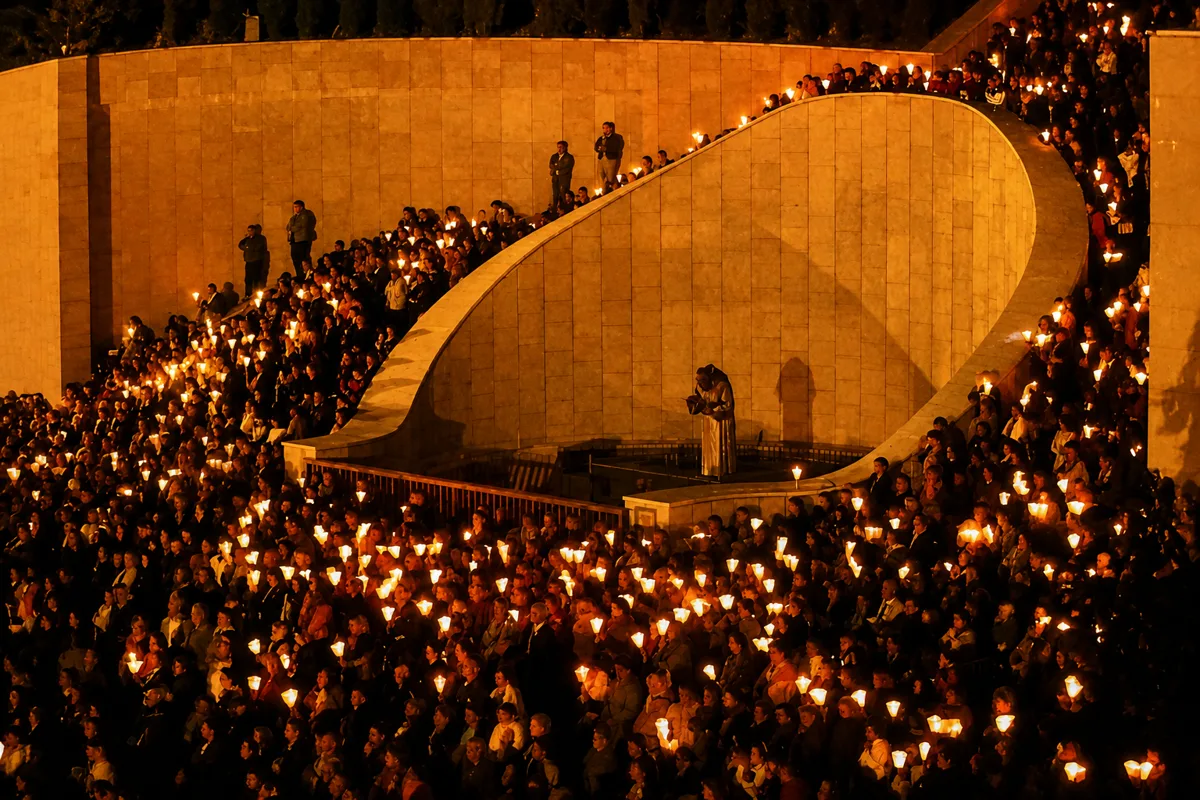
You don’t have to be a believer for San Giovanni Rotondo to affect you. In the evening, when thousands gather with a candle in hand for the procession, there’s something you feel in your chest before your head.
This Gargano town is one of the most visited places of pilgrimage in the world, and the reason has a single name: Padre Pio. But behind the crowds there’s a story of a friar, a hospital built almost from nothing, and a modern church by one of the great contemporary architects. It’s worth knowing before you arrive.
What to see in San Giovanni Rotondo
1. Who Padre Pio was
Padre Pio of Pietrelcina (1887-1968) was a Capuchin friar who lived in San Giovanni Rotondo, at the friary of Santa Maria delle Grazie, from 1916 until his death. In life he was both a debated and deeply venerated figure: he was said to bear the stigmata — the wounds of the Passion, which he reportedly carried for around fifty years — and extraordinary gifts. He was canonized in 2002 by John Paul II, and is today one of the most beloved and popular saints in the Catholic world.
Understanding the devotion to Padre Pio is the key to understanding why a small mountain town became a capital of pilgrimage.
2. The Shrine of Santa Maria delle Grazie
The historic heart is the Shrine of Santa Maria delle Grazie: the small old church and the friary where Padre Pio lived, prayed and heard confession for decades. Beside it, in 1959, a larger church was built to receive the ever-growing crowds. Here you feel the most intimate, personal dimension of the place: the cells, the friar’s spaces, the origin of it all.
3. The new Renzo Piano church
To welcome by then enormous crowds, a new large church was built, dedicated to Saint Pius of Pietrelcina and designed by Renzo Piano, consecrated in 2004. It’s one of the largest places of worship in Italy: a great modern structure of stone arches, able to hold thousands of people.
The crypt holds the body of Padre Pio, the destination of the constant flow of pilgrims. The contrast between the contemporary architecture and the age-old devotion is one of the most interesting things to observe here.
4. The evening candlelight procession
Every evening, San Giovanni Rotondo gathers for the candlelight procession: thousands of candles lit in the dark, a slow march, a silence made of low voices and prayer. It’s the most intense moment of the day, and the one that strikes even those who arrive as simple travellers. It’s not a show for tourists: it’s the daily form of a living faith, which you happen to be allowed to watch.
5. The Casa Sollievo della Sofferenza
A short distance from the shrines stands the Casa Sollievo della Sofferenza (“Home for the Relief of Suffering”), the hospital Padre Pio wanted and had built, opened in 1956. It’s not a stop to “visit” like a monument, but it’s an essential part of the story: it tells of a concrete, social side of his work, the idea that caring for the sick was part of faith as much as prayer. Today it’s a hospital of national importance.
6. Why it’s called “Rotondo”
The town’s name doesn’t come from Padre Pio: it’s far older. It derives from an ancient round-plan building — an early-Christian baptistery, said by tradition to have risen on a pre-existing temple — linked to the worship of Saint John. A detail that reminds you this land was a place of faith long before the 20th century.
7. How to find your way around and practical tips
The shrine area is compact and walkable: the old shrine, the new church and the crypt are close together.
- Expect the crowds: at weekends, on feast days and in summer the town is packed. Arrive early.
- Respectful clothing: this is a place of living worship.
- Pair it with Monte Sant’Angelo: the two poles of the sacred Gargano — the archangel and the friar — are a short distance apart and visit well together.
What the usual guides don’t show you
Guides tell you there’s the tomb of Padre Pio and a huge church. They don’t tell you why a mountain friar moved millions of people, what the pilgrims who climb up here are looking for, how faith built — literally — a town, a hospital, a basilica.
The audio story The Sacred Mountain — Forest, Faith and Pilgrims tells exactly the Gargano of pilgrims: the faith that shaped this mountain, from Saint Michael to Padre Pio. It doesn’t replace the visit — it gives it a backdrop.
Frequently asked questions about San Giovanni Rotondo
Where is the body of Padre Pio?
The body of Padre Pio is kept in the crypt of the new church dedicated to Saint Pius of Pietrelcina, designed by Renzo Piano. It’s the pilgrims’ main destination.
Who designed the new church in San Giovanni Rotondo?
The new large church, consecrated in 2004, was designed by the architect Renzo Piano. It’s one of the largest places of worship in Italy.
How long do you need to visit San Giovanni Rotondo?
Half a day is enough for the shrines, the crypt and a stop. Those who also want to experience the evening procession should plan to stay until evening or overnight.
What is the Casa Sollievo della Sofferenza?
It’s the hospital wanted by Padre Pio and opened in 1956, today a hospital of national importance. It represents the social, concrete side of his work.
Are San Giovanni Rotondo and Monte Sant’Angelo close?
Yes, they’re both on the Gargano and a short distance apart. Together they form the classic “sacred Gargano” itinerary: the Shrine of Saint Michael and the places of Padre Pio.
Sources and method
This article is written and reviewed by Localis. The project’s sources are collected on the Sources page. For the full editorial method, see The Localis method.