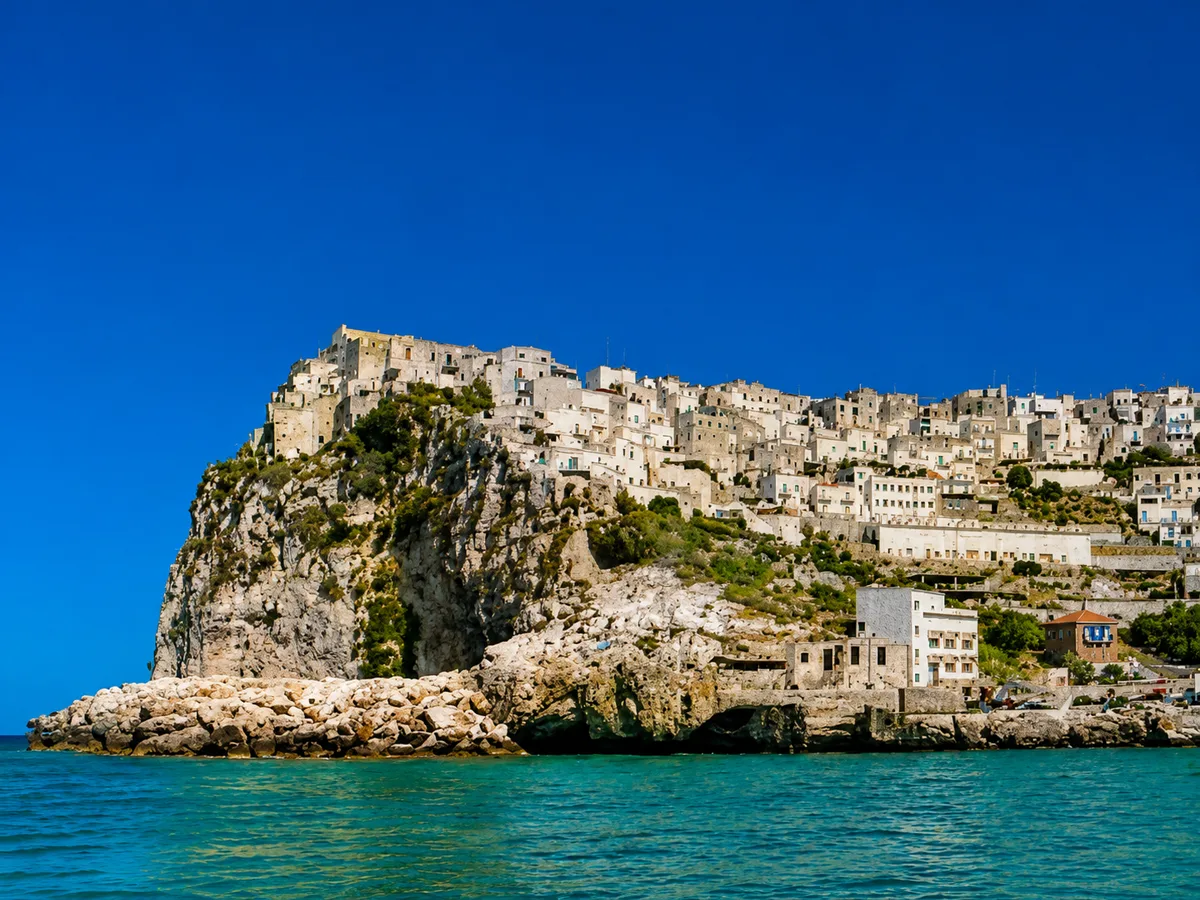
The first time you see Peschici, it should be from the sea. You arrive by boat and the town appears all at once: a cluster of white houses planted on top of a pale rock cliff, hanging over the water as if it might slide in at any moment.
That position isn’t just for the postcard. A town doesn’t end up on top of a cliff by accident. Peschici sits up there for the same reason almost every town on the Gargano coast sits high: for centuries, the sea was also a threat. Understanding that changes what you see once you climb up into it.
This is a guide to finding your way around Peschici — and to reading the town, not just photographing it.
What to see in Peschici, in the right order
1. The old town: the white village
The heart of Peschici is its medieval old town, a maze of narrow lanes, arches, stairways and courtyards, all lime-washed white. The whitewash isn’t only decorative: it reflects the sun, keeps the houses cool in summer, and for centuries served a hygienic purpose too. The result is a white labyrinth opening onto blue, with sea views appearing suddenly at the end of an alley.
As you walk you notice the rounded chimneys and the cube-shaped houses pressed together — an architecture closer to the eastern Mediterranean and North Africa than to inland Italy. That’s no illusion: it’s the mark of centuries of trade, and of arrivals, along this coast.
Getting around: the centre is small and walkable only on foot. Let yourself get lost in the lanes, then head for the highest point, where the castle stands.
2. The castle and the town’s Slavic origins
At the top of the town, dominating the cliff, stands the Castle of Peschici, of early-medieval origin and rebuilt many times. From its position it commands the whole coast: that was exactly its job.
Here’s the piece of history almost no visitor knows. According to the 17th-century historian Pompeo Sarnelli, Peschici’s origins go back to around the year 970, when a group of Schiavoni — a Slavic people — led by a captain named Sueripolo is said to have settled here to guard the coast. It’s a handed-down account, not archaeological certainty, but it fits the town’s character perfectly: born as an outpost, built to watch the sea and defend against those who came by it.
3. The trabucchi: fishing without going out to sea
Along the coast around Peschici you’ll see wooden structures reaching out over the water, made of beams, winches and big square nets: these are the trabucchi, ancient fishing machines typical of the Gargano and the whole Adriatic coast up to Abruzzo.
They let fishermen work while anchored to the rock: the net is lowered from the platform and catches the fish passing close to shore on the currents, with no need to face the open sea. Building and maintaining one took timber, hard work and a knowledge of the sea passed from father to son. Today several trabucchi have been restored and some work as restaurants — they remain the most tangible sign of a relationship with the sea built on patience, not engines.
4. The beaches and sea caves
Below the town, the Marina di Peschici and the main beach are the easiest to reach. East and west, the coast opens into a series of bays and coves: the Baia di San Nicola, Manacore, and the inlets along the road to Vieste.
But the highlight is the sea caves: the Gargano coast between Peschici and Vieste is carved with dozens of caverns, natural arches and inlets reachable only from the water. In high season, boat trips leave the harbour and run from one to the next. If you just want a swim, the marina is enough; if you want to understand this coast, take the boat.
5. The Abbey of Santa Maria di Calena
A few kilometres outside the town, towards Vieste, stands the Abbey of Santa Maria di Calena, one of the oldest monastic complexes on the Gargano, tied for centuries to the area’s religious and agricultural history. It’s off the mass-tourism circuit, and that’s exactly why it’s worth the detour: it tells of a Gargano made not only of beaches, but of monks, cultivated land and pilgrimages.
6. How to find your way around Peschici
The town’s geography is simple once you see it from above:
- The white old town sits on top of the rock spur, with the castle at the highest point.
- The harbour and the Marina lie at the foot of the town.
- The beaches and bays stretch east and west along the coast.
- The scenic road to Vieste runs past cliffs, trabucchi and coves.
In summer, a car in the centre is more trouble than convenience: park outside and walk.
7. What to eat in Peschici
Seafood, first of all: fresh fish, shellfish, the catch that comes in from the harbour and, where they still work, from the trabucchi. But the Gargano is also inland: caciocavallo podolico, made from the Podolica cows that graze the high plateau, and the Gargano citrus — oranges and lemons with their own protected status — are the counterpoint from the land.
The rule here is the same as ever along this coast: where the fishermen eat, you eat well.
How long you need and when to go
One day: old town, castle, one beach. The essentials.
Two or three days: add the boat trip to the caves, an excursion to Vieste or inland, and time to wander the lanes without rushing.
When: June and September are the best months — good sea, but without the crowds and prices of August, when Peschici is beautiful and packed.
What the usual guides don’t show you
Maps tell you where things are. They don’t tell you why the town is white, why it’s perched on the rock, why a Slavic people would have come all the way up here a thousand years ago to guard the coast.
The audio story The North Coast — Trabucchi, Villages and Sea is built on that why: it doesn’t list the stops, it tells them, while you walk. It doesn’t replace the visit — it gives it a backdrop.
Frequently asked questions about Peschici
How many days do you need to visit Peschici?
For the old town and one beach, a day is enough. To also enjoy the caves by boat and the surroundings (Vieste, the inland, the Calena abbey), allow two or three days.
How do you get to Peschici?
Peschici has no main-line railway station of its own. You arrive by car along the Gargano coast road, or by bus from the main towns of Puglia; in summer there are also sea connections. The nearest airports are Bari and Foggia.
Peschici or Vieste — which is better?
They’re different. Vieste is larger, livelier and has a bigger old town; Peschici is smaller and more compact, with a cliff-top view that’s hard to beat. For a quieter base, Peschici is the right choice.
Can you visit the sea caves from Peschici?
Yes. In high season, boat trips leave the harbour and run along the coast between Peschici and Vieste, which is full of caves, natural arches and coves reachable only from the water.
Is Peschici good for a family holiday?
Yes: it has serviced beaches at the marina, a small old town that’s safe to explore on foot, and the boat trips are an experience children enjoy too. The only catch is the town’s uphill lanes, awkward with a pushchair.
Sources and method
This article is written and reviewed by Localis. The project’s sources are collected on the Sources page. For the full editorial method, see The Localis method.