Monte Sant’Angelo sits on top of the Gargano, at around eight hundred metres, one of the highest towns on the promontory. But the altitude isn’t why people climbed up here for fifteen centuries. The reason is a cave.
From that cave grew a town, a pilgrimage that crossed Europe, and a piece of history that today is World Heritage. Most visitors come up for the shrine and leave. But the real Monte Sant’Angelo is also in the white lanes, in the almonds drying in the sun, in the slow rhythm of a mountain town that still lives by its seasons.
What to see in Monte Sant’Angelo
1. The Shrine of Saint Michael the Archangel: the church inside the rock
The heart of it all is the Shrine of Saint Michael the Archangel, built around a natural cave. Tradition holds that here, at the end of the 5th century, the Archangel Michael appeared several times, marking the place as sacred and already consecrated by his presence: so the cave was never “built”, but received.
It’s one of the oldest and most important shrines to Saint Michael in the West. For centuries it was a key stop on the pilgrimage routes — the Via Sacra Langobardorum — linking northern Europe to the Holy Land: those heading down to Jerusalem passed through here. You enter by descending a stairway into the cave, where the air changes and the silence feels different. It’s the oldest and most charged point in the whole town.
2. UNESCO World Heritage: the Lombards and the Gargano
Since 2011 the shrine has been a UNESCO World Heritage Site, within the serial property “Longobards in Italy. Places of Power (568-774 A.D.)”. It was the Lombards who made Monte Sant’Angelo a leading religious and political centre, adopting Saint Michael — the heavenly warrior — as protector of their people.
Understanding this changes the visit: you’re not looking at a simple mountain church, but at one of the places that defined power and faith in early-medieval Europe.
3. The Angevin bell tower
Beside the shrine rises the octagonal bell tower, built in the Angevin period (around 1274) at the wish of Charles I of Anjou. Its tower form makes it one of the city’s architectural symbols and a landmark visible from afar: it also served to signal, from up there, the presence of the sacred site.
4. The Tomb of Rotari and the monumental complex
A short distance from the shrine stands the so-called Tomb of Rotari, a domed building of debated purpose (probably a medieval baptistery), part of a monumental complex that includes the church of San Pietro and the remains of Santa Maria Maggiore. It’s one of the most fascinating parts of the old town, where the stone tells of centuries layered on centuries.
5. The Junno district: white houses in rows
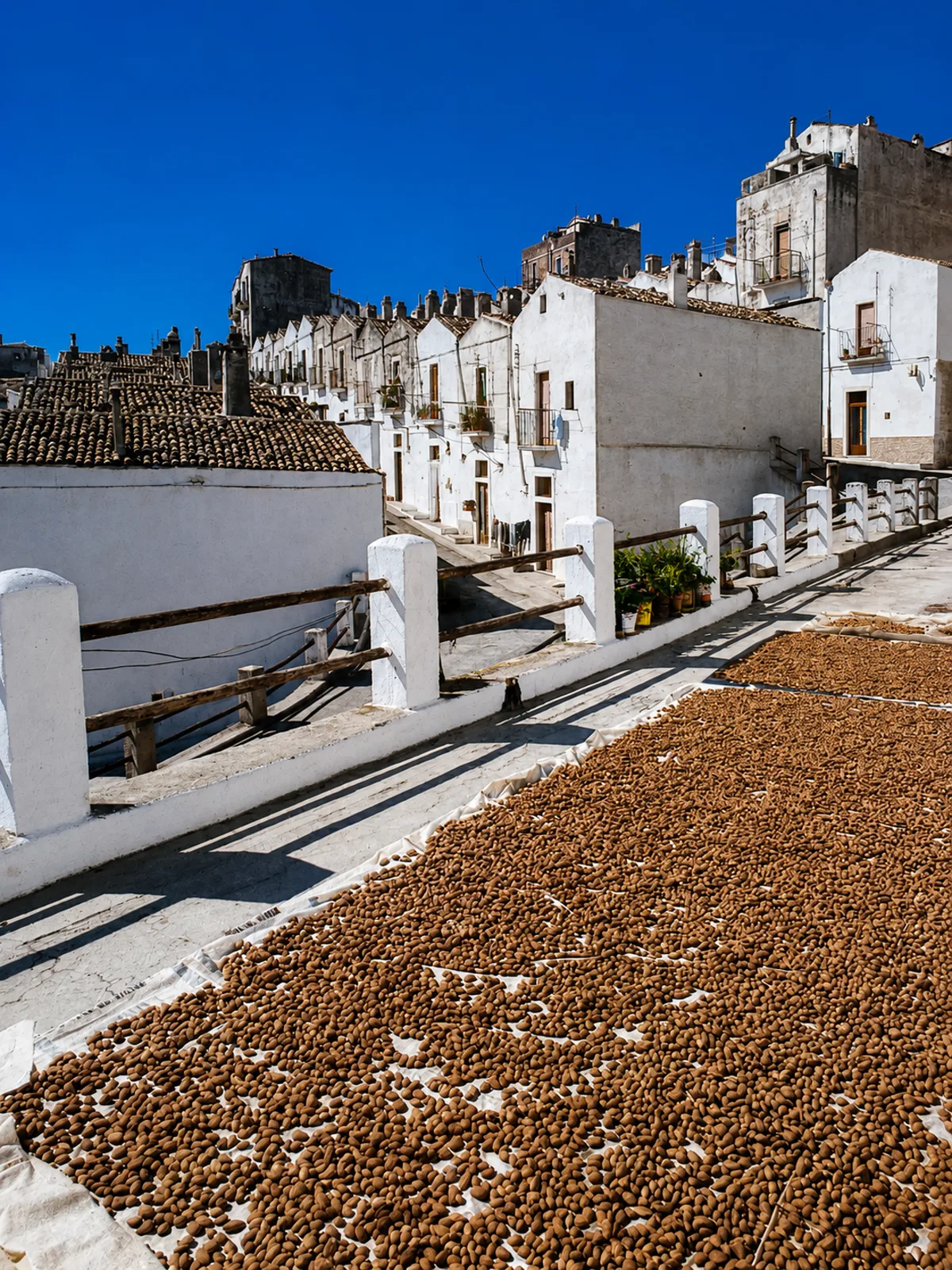
Away from the shrine’s crowds, the Junno district is the domestic face of Monte Sant’Angelo: rows of small white houses, low and pressed together, with chimneys and doorways opening straight onto the lane. It’s the town’s working-class architecture, simple and orderly, and the right place to understand how people lived up here when there were no pilgrims around.
6. Almonds in the sun and the sweets
In summer, in the streets and on the terraces of Monte Sant’Angelo, you’ll find almonds laid out to dry in the sun, on sheets, outside the doors. It’s not a show: it’s how the harvest has been handled for generations.
Those almonds end up in the town’s typical sweets, such as the ostie ripiene — two thin wafers enclosing almonds and warm honey. Trying them is the most direct way to take the taste of this place home.
7. How to find your way around and when to go
The old town is compact and steep: you explore it on foot. The shrine, the bell tower and the Tomb of Rotari are close together; the Junno district is a short walk away.
- Dress in layers: at eight hundred metres, even in summer, the cave is cool and the wind blows.
- Respect the place: the shrine is a site of living worship, not just a monument.
- When: lovely all year; livelier in summer, but the altitude makes it pleasant even when it’s scorching on the coast.
Monte Sant’Angelo pairs well with San Giovanni Rotondo for a tour of the sacred Gargano.
What the usual guides don’t show you
Lists tell you there’s a UNESCO shrine. They don’t tell you why a cave became a town, what the pilgrims who climbed up here were looking for, why the Lombards chose a warrior archangel.
The audio story The Sacred Mountain — Forest, Faith and Pilgrims tells exactly that why: the faith, the forest and the pilgrims who made the Gargano a sacred mountain. It doesn’t replace the visit — it gives it depth.
Frequently asked questions about Monte Sant’Angelo
Why is Monte Sant’Angelo a UNESCO site?
The Shrine of Saint Michael has been on the UNESCO list since 2011 as part of the site “Longobards in Italy. Places of Power (568-774 A.D.)”, for its religious and political role in the early Middle Ages.
What is there to see in the Shrine of Saint Michael?
You descend a stairway to the natural cave around which the shrine is built, one of the oldest sites of Michaeline worship in Europe. Beside it are the Angevin bell tower and the monumental complex.
How long do you need to visit Monte Sant’Angelo?
Half a day is enough for the shrine, the bell tower, the Tomb of Rotari and a walk through the Junno district. With a relaxed pace and a food stop, a full day.
How should you dress to visit the shrine?
Dress in layers: the altitude of around eight hundred metres and the cave keep the air cool even in summer. As it’s a place of worship, respectful clothing is appropriate.
What do you eat in Monte Sant’Angelo?
Almond sweets are the stars, in particular the ostie ripiene. The locally worked almond is the town’s signature product, alongside the mountain cuisine of the Gargano.
Sources and method
This article is written and reviewed by Localis. The project’s sources are collected on the Sources page. For the full editorial method, see The Localis method.