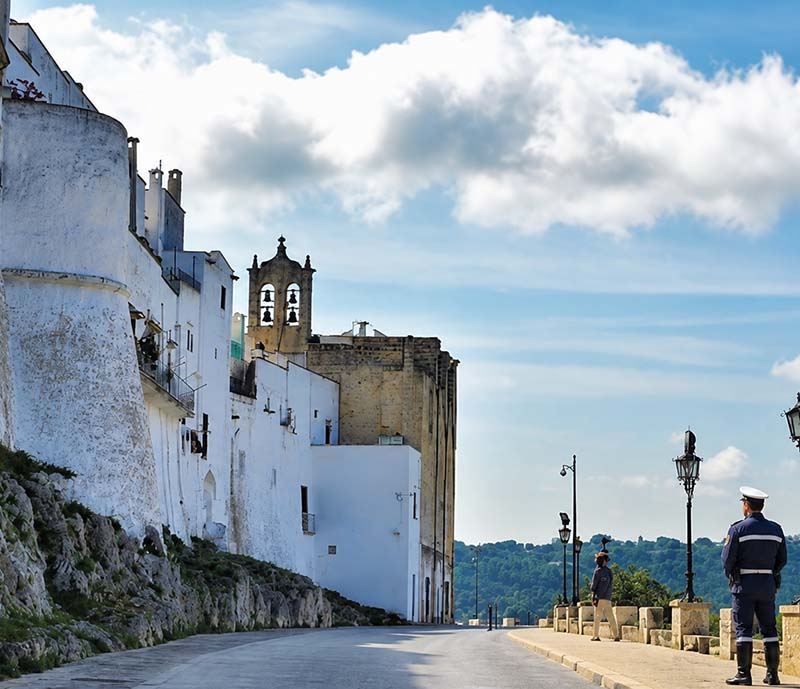
You see Ostuni from far away: a white hill standing out from the green of the olive groves, visible from kilometres off. It’s the “White City”, and the name isn’t marketing hype — it’s the result of centuries of lime spread on the walls, for reasons that have little to do with looks. Behind that white lie a Messapian town, a medieval maze and one of the most important prehistoric burials in Europe.
This guide is for reading Ostuni, not just looking at it.
What to See in Ostuni, in the Right Order
1. Why Ostuni is white
The old town is entirely lime-washed white. The reason is practical: lime was cheap, it reflects the sun and keeps the houses cool, and it disinfects too — no small thing in centuries of epidemics. Over time that white became Ostuni’s identity, but it began as hygiene and survival.
The right way to see it is to get lost in the alleys climbing towards the top: stairs, arches, buttresses, white houses on white houses.
2. The cathedral: Gothic in Puglia
At the top of the town stands the Co-Cathedral of Santa Maria Assunta, built between the 15th and early 16th centuries. It’s a rarity: Gothic is uncommon in Puglia, and Ostuni has a notable example, with a large, finely worked rose window on the façade.
It’s the highest point of town and the best view: from here the white roofs cascade down to the countryside.
3. The old town and the Jewish quarter
The town is a medieval maze designed for defence: narrow alleys, climbs, dead ends. Inside is also the Giudea, the old Jewish quarter, the trace of a community that for centuries was part of the city’s life before the expulsions of the Aragonese era.
Walk without hurrying: in Ostuni the thing to see is the very fabric of the town, more than the single monuments.
4. The Delia: the woman of Ostuni
Just outside the centre, the Museum of Pre-Classical Civilisations of the Murgia holds one of the most extraordinary things in all of Puglia: the skeleton of a young pregnant woman, buried about twenty-five thousand years ago, found in the nearby caves. She’s called the Delia, and she is one of the most important Palaeolithic burials in Europe.
She’s the perfect counterpoint to the touristy white: a reminder that people have lived here since before written history.
5. The oil and the countryside around
Ostuni sits amid a sea of centuries-old olive trees, some millennia old, and olive oil (cultivars like Ogliarola and Cellina di Nardò) is one of the deep reasons for its historic wealth. Around the town, the fortified masserie (farmsteads) tell the other Puglia: of working the land, the stone and the flocks.
The sea is a few kilometres away, along the coast of Marina di Ostuni: the white city looks out over the Adriatic from the top of its hill.
How Long You Need and When to Go
Half a day is enough for the old town, the cathedral and the museum. Ostuni is walkable, but uphill: factor that in.
When: on summer evenings the town lights up with bars and tables, but that’s also the most crowded time. For the white in the best light, go early morning or at sunset. It combines well with the rest of the Itria Valley — Alberobello and Locorotondo are nearby.
What the Usual Guides Don’t Show
Photos show the white. They don’t tell you why the town is whitewashed, what lime has to do with epidemics, who lived in the Giudea, why a woman buried twenty-five thousand years ago lies just a step away.
The Ostuni — The White City audio story tells exactly the whys: it doesn’t list the alleys, it explains what made them this way. A little over half an hour that changes what you see as you climb.
Frequently Asked Questions about Ostuni
How long do you need to visit Ostuni?
Half a day is enough for the old town, the cathedral and the museum of the Delia. It’s a stop easily combined with the rest of the Itria Valley.
Why is Ostuni called the White City?
Because the old town is entirely lime-washed: a choice born of practical reasons — low cost, cool in summer, hygiene — that over time became the city’s identity.
Can you drive into the old town?
The old town is largely pedestrian and uphill. It’s best to park in the lower town and climb on foot.
Is Ostuni on the sea?
No: Ostuni sits on a hill, but the sea and the beaches of Marina di Ostuni are a few kilometres away. The city looks out over the Adriatic from above.
What is there to see around Ostuni?
The Itria Valley with its white towns and trulli (Alberobello, Locorotondo, Cisternino), the masserie with their centuries-old olive trees, and the Adriatic coast.
Sources and method
This article is written and reviewed by Localis. The project’s sources are collected on the Sources page. For the full editorial method see The Localis method.