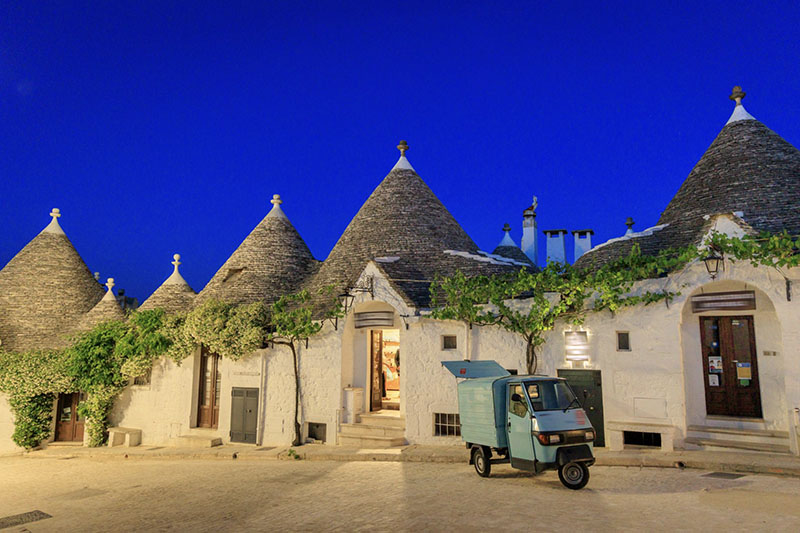
Alberobello is one of the most photographed places in Puglia, and one of the most misunderstood. The trulli look like a picturesque postcard — conical roofs, little stone houses — but behind that shape lies a story of dodged taxes, feudal lords and a building trick that became World Heritage. Understanding it completely changes what you see.
This guide is for not stopping at the photo.
What to See in Alberobello, in the Right Order
1. What a trullo really is
A trullo is a dry-stone construction: walls and a conical roof raised by fitting the stones together without mortar, without cement, with nothing holding them but weight and geometry. The roof is made of slabs (the chiancarelle) set in concentric rings up to the pinnacle.
It’s not just ancient technique: it’s the key to Alberobello’s whole story. A house without mortar can be taken apart quickly — and here, that mattered for centuries.
2. The story nobody tells you: 1797
To understand Alberobello you need to know why it exists. The area was a fief of the Counts of Conversano, the Acquaviva, who — to avoid the taxes the Kingdom levied on every new town — forced the peasants to build without mortar: dismountable houses that, when an inspection arrived, could be made “not houses”. A whole town built to be able to disappear.
It ended in 1797, when King Ferdinand IV of Bourbon raised Alberobello to a royal town, free of the fief. From then on people could build permanently — but the shape of the trulli had already become the place’s identity.
3. Rione Monti: the showcase
Rione Monti is the slope with the highest concentration of trulli: over a thousand, along climbing alleys. It’s the Alberobello of the photos, and also the most touristy: many trulli are now shops and workshops.
The climb is worth it anyway, especially early morning or at sunset, when the light cuts across the roofs and the crowds thin. At the top, the trullo-church of Sant’Antonio, built in trullo style in the 20th century.
4. Aia Piccola: the real one
On the other side of town, the Aia Piccola district is where the trulli are still mostly lived-in homes, not shop windows. Fewer shops, fewer people, more real life. It’s here you understand what it means to inhabit a trullo, with the washing out and the vegetable gardens behind.
If you’re short on time and want one authentic thing, choose Aia Piccola.
5. The Trullo Sovrano and the rooftop symbols
The Trullo Sovrano is the only two-storey trullo, built in the 18th century: proof that dry stone could make “important” buildings too. Today it’s a small museum showing what a trullo home was like inside.
Then look at the pinnacles atop the cones and the symbols painted in white on some roofs: religious, magical, astronomical signs. Their origin is uncertain, but they’re part of the town’s visual language.
How Long You Need and When to Go
Half a day is enough for the two districts, the Trullo Sovrano and Sant’Antonio. Alberobello is small and entirely walkable.
When: early morning or late afternoon, to avoid the coaches and the midday crush. Alberobello is a perfect short stop to combine with the rest of the Itria Valley — Locorotondo and Ostuni are a few kilometres away.
What the Usual Guides Don’t Show
Photos show the conical roofs. They don’t tell you why they’re built without mortar, what taxes and feudal counts have to do with it, why a whole town was built to be able to “disappear”, what it means to live in a trullo today.
The Alberobello — Inside the Trulli audio story tells exactly this: it doesn’t list the monuments, it explains the stone. Half an hour that turns a postcard into a story.
Frequently Asked Questions about Alberobello
How long do you need to visit Alberobello?
Half a day is enough to see Rione Monti, Aia Piccola and the Trullo Sovrano. It’s a stop easily combined with the rest of the Itria Valley.
Can you go inside the trulli for free?
Walking among the trulli is free. Some trullo-museums and the Trullo Sovrano charge a small ticket. Many trulli in Rione Monti are shops with free entry.
Why are the trulli built without mortar?
For tax reasons: the fief required dismountable buildings to dodge the Kingdom’s levies on towns. Houses without mortar could be “undone” if an inspection came.
What’s the difference between Rione Monti and Aia Piccola?
Rione Monti is the more touristy area, with many trullo-shops. Aia Piccola is more residential and authentic, with trulli still lived in. For the real atmosphere, choose Aia Piccola.
Is Alberobello a UNESCO site?
Yes, the trulli of Alberobello have been a UNESCO World Heritage Site since 1996.
Sources and method
This article is written and reviewed by Localis. The project’s sources are collected on the Sources page. For the full editorial method see The Localis method.