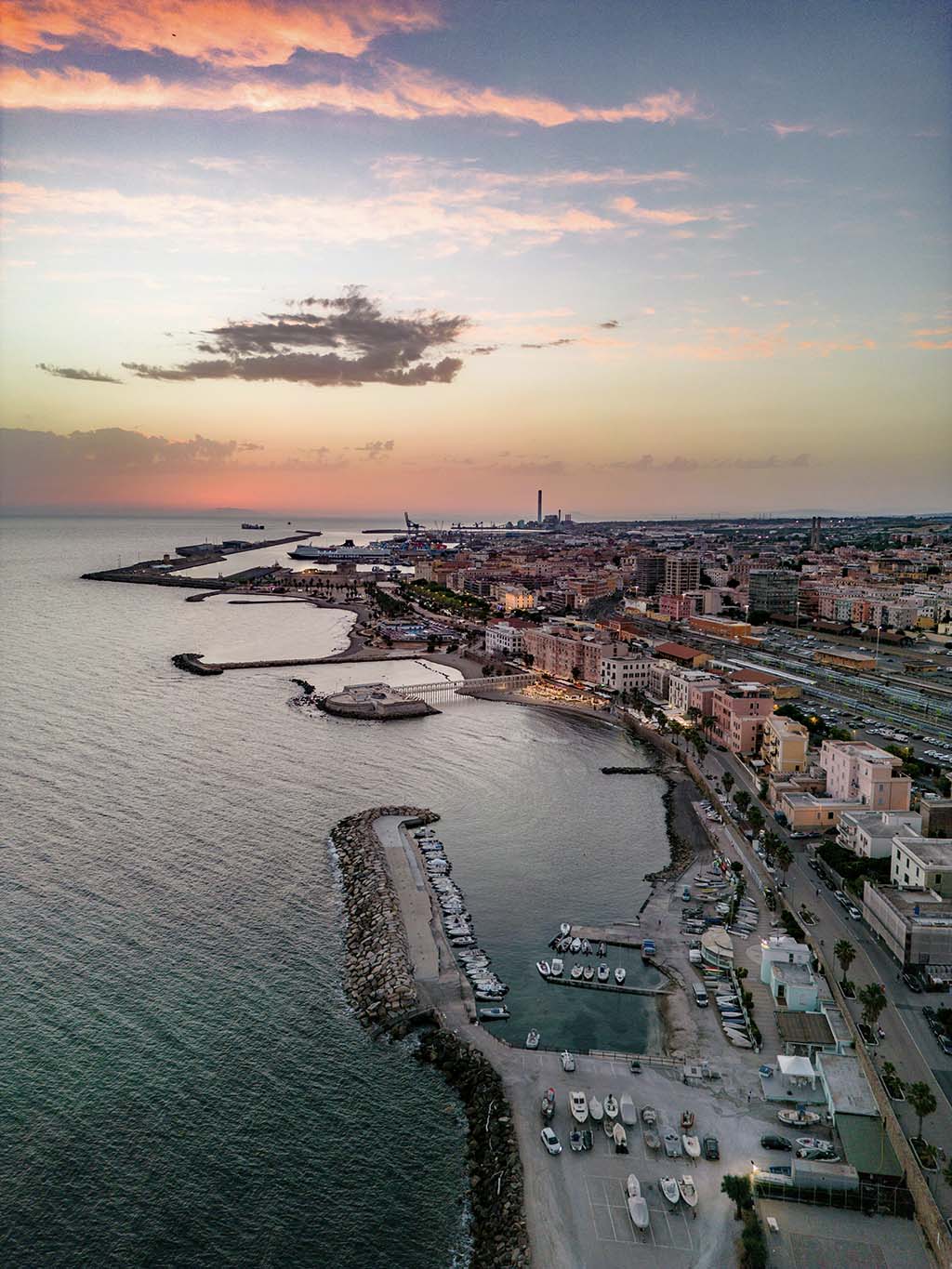
The Port of Bari has never been just a port. It was the gateway through which the East entered Europe, the point of departure for thousands of pilgrims and crusaders, the place where Saint Nicholas arrived from Myra in 1087, and the spot where, one night in December 1943, a German bomb struck a ship loaded with mustard gas and changed the course of a war. This article traces that history, from the Roman settlement all the way to the twentieth century.
The Roman port: terminus of the Via Traiana
Bari’s position on the Adriatic is no accident. The limestone headland offers natural shelter for ships crossing the Strait of Otranto, and the Romans knew it. Barium became the end node of the Via Traiana, the consular road commissioned by the emperor Trajan at the start of the second century AD to link Benevento to the Adriatic as an alternative to the older Via Appia.
The road ended at the quayside. From the Port of Bari ships set out for Greece, for the East, for Constantinople. Coming the other way were goods, officials, soldiers. Even then the port was the point where the Mediterranean world drew itself together onto a single pier.
The Arabs in Bari: twenty-five years of an emirate (847–871)
In 847 an Arab fleet captured Bari and turned it into the centre of an independent emirate. For twenty-five years the city was the only Arab-Islamic territory on the Italian mainland — an anomalous, unstable presence, but one that lasted long enough to leave deep marks on trade and on the life of the city.
The emirate ended in 871, when a coalition led by the Eastern emperor Louis II wrested Bari from the Arabs after a long siege. The port returned to Christian control, but commercial contact with the Arab world did not break off: Bari’s merchants kept trading along the routes that the Arab years had opened.
The translation of Saint Nicholas: 9 May 1087
9 May 1087 is the most important date in the history of the Port of Bari. That day a ship docked carrying the relics of Saint Nicholas, bishop of Myra, taken from the coast of Asia Minor by an expedition of Bari sailors.
The port was the first place in Bari to set eyes on the saint. The relics were brought ashore in the middle of the crowd, received by the city’s clergy, and carried in procession towards what would become the Basilica of Saint Nicholas. That arrival turned Bari into a pilgrimage destination and the port into a waypoint for the faithful from across the Christian Mediterranean.
On the saint and the Basilica, The History of Saint Nicholas in Bari lays out the full picture.
The port of the crusaders (1096–1200)
Bari was one of the main ports of embarkation for the First Crusade. In the summer of 1096, while Godfrey of Bouillon’s troops were marching overland towards the East, thousands of pilgrims and fighters made their way to the ports of Puglia to cross the Adriatic.
The preacher Peter the Hermit — the figure who, more than any other, had kindled popular enthusiasm for the crusade by travelling across Europe with his preaching — passed through Bari and put part of his following on ships bound for the Levant. The port watched people of every background set sail: Norman knights, French peasants, German pilgrims, all heading for Jerusalem from the same quay.
Throughout the twelfth century the Port of Bari remained a waypoint for those bound for the Holy Land and for the merchants trading with the eastern Mediterranean. The Norman presence guaranteed order and safety along the routes; Bari profited from the commercial traffic that followed in the crusade’s wake.
The port in the Middle Ages: merchants, pilgrims and grain
Between the twelfth and fourteenth centuries the Port of Bari was already fully woven into the routes of the medieval Mediterranean. Bari’s ships traded with Venice, with Ragusa (today’s Dubrovnik), with the ports of Greece and the Levant. The city’s merchants had standing agents in Constantinople and ties with the Jewish communities of the eastern Mediterranean.
Pilgrims bound for the Basilica of Saint Nicholas arrived by sea too. Medieval chronicles describe the port as a noisy, crowded place, with ships moored two deep and goods piled up on the wharves. The grain of Puglia — the most important agricultural resource in southern Italy — went out from here towards the markets of the North.
Murat’s Bari and the modern port
The most visible transformation of the Port of Bari came at the start of the nineteenth century, with Joachim Murat and the project for Bari Nuova. The modern quarter — with its regular grid of streets inspired by French models — was built to the north of the old city and changed the relationship between port and town.
The port was enlarged and modernised over the course of the nineteenth and twentieth centuries, gradually becoming a commercial port on a regional scale. The building of the present quays and harbour warehouses reshaped the whole northern part of the city.
2 December 1943: the night of the port
The night of 2 December 1943 has gone down in history as the Bari Raid — or, as the Allies called it, the “little European Pearl Harbor”.
By that time Bari had become one of the main supply ports for the Allied forces advancing north up the Italian peninsula. Dozens of cargo ships were moored in the harbour, loaded with matériel, fuel and weapons. One of them, the John Harvey, was carrying a secret cargo of mustard gas bombs — a chemical agent from the First World War, kept hidden for strategic reasons.
The Luftwaffe attacked Bari that night with more than a hundred bombers, sinking seventeen Allied ships. The sinking of the John Harvey released the mustard gas into the harbour and the sea. The casualties were heavy: soldiers, sailors, Bari civilians living in the houses near the port. The precise figures are still debated by historians, but estimates speak of hundreds of dead among military personnel and civilians, with many cases of gas poisoning left undiagnosed in the weeks that followed.
The silence that surrounded the incident for decades — owing to the secrecy over the cargo of chemical weapons — made the night of 2 December 1943 one of the darkest episodes in Bari’s recent history.
The port today
The Port of Bari is today one of the busiest in the central Mediterranean, with ferry traffic to Greece and Croatia, cruise ships that choose Bari as a port of call, and a growing freight terminal. The Saint Nicholas quay — the historic pier that looks out at the castle — is the spot where the old port and the new city still meet.
From that quay you see exactly the skyline the medieval sailors saw when they came back from Constantinople, the same one the crusaders’ ships saw as they left Puglia for the East, and the American cargo ship of 1943 saw on that night in December. The Port of Bari has a long memory.
The audio story of the port
Walking through the Port of Bari knowing what happened here is a different experience from any ordinary stroll. The Port of Bari — Where It All Happened audio story follows the route through thirteen narrated chapters, from the Romans to the night of 1943, without skipping a single layer.
It’s not a checklist of monuments. It’s a story that leaves the port fuller of meaning than it was when you walked in.
Frequently asked questions about the Port of Bari
Why was the Port of Bari so important in the Middle Ages?
Bari’s geographical position — facing Greece, halfway between East and West — made it the natural transit point for goods and people crossing the Adriatic. On top of that, the presence of the relics of Saint Nicholas drew pilgrims who arrived by sea as well.
Did the crusaders really set out from Bari?
Yes. Bari was one of the main ports of embarkation for the First Crusade in 1096, alongside Brindisi and Otranto. The preacher Peter the Hermit passed through Bari during his march to the Adriatic.
What happened to the Port of Bari in 1943?
On 2 December 1943 the Luftwaffe attacked the port with more than a hundred bombers, sinking seventeen Allied ships. One of the ships hit was carrying mustard gas bombs, and their release caused an undetermined number of casualties among military personnel and Bari civilians. The episode is known as the Bari Raid.
How long does it take to visit the Port of Bari?
A walk along the historic quays, from the Lungomare Imperatore Augusto to the Saint Nicholas pier, takes about forty minutes at a steady pace. With the audio story, the route runs to roughly thirty-three minutes of narration — plus the time you spend pausing and looking.
Does the audio story about the port also cover the old town?
No, the two stories are separate. The story about Old Bari covers the old town; the story about the port focuses on the harbour area and the waterfront. Buying them together with the Complete Bari bundle costs less than buying them on their own.
Sources and method
This article was written and reviewed by Localis from the same base of historical research used for the audio story of the port. The main sources include studies on the ninth-century Emirate of Bari, the chronicles of the First Crusade, and the historical documentation on the Bari Raid of 1943.
The project’s sources are collected on the Sources page and on the guide page Port of Bari — Where It All Happened. For the full editorial method see The Localis method.