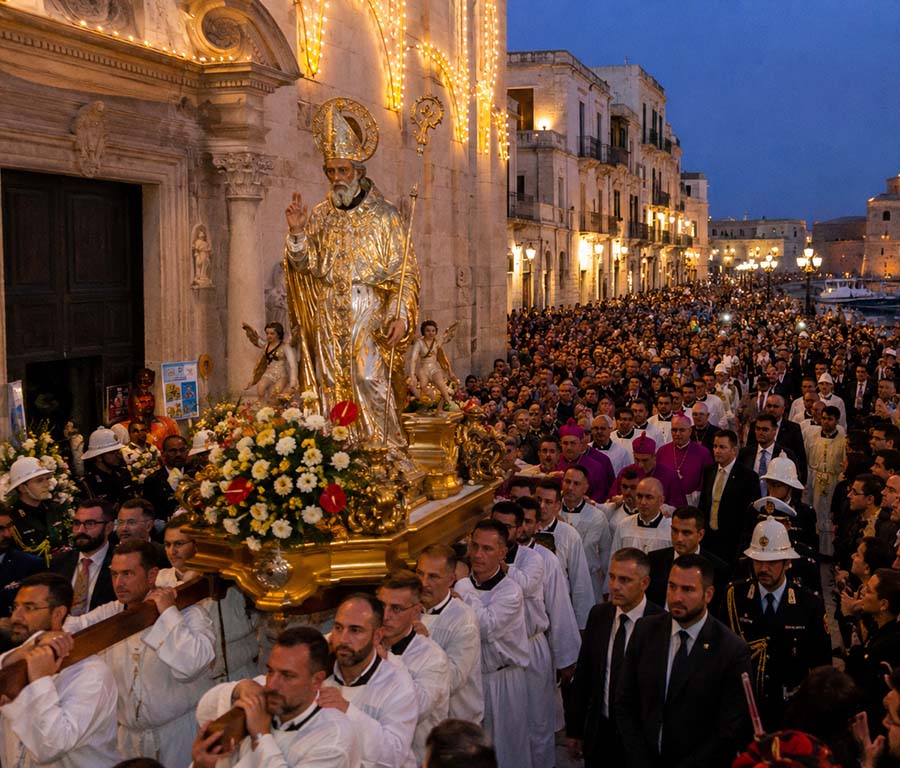
Saint Nicholas wasn’t born in Bari. He was born much further east, in Myra, in what is now southern Turkey, and he died there in the 4th century. And yet for nearly a thousand years his name has been inseparable from the old town, from the Romanesque basilica by the sea, and from the May feast that every year fills Bari with processions, pilgrims and boats.
This article gives you the historical picture to understand why Saint Nicholas matters so much to Bari. The Localis audio story does something different: it doesn’t turn the Basilica into a list of dates and capitals, it helps you read what you’re looking at. Seeing is easy. Understanding is another thing entirely.
Who Nicholas of Myra Was
Nicholas lived between the 3rd and 4th centuries, in Lycia, a region of Asia Minor facing the Mediterranean. According to tradition he was born in Patara, into a well-off Christian family, and became bishop of Myra at a young age.
His historical figure is buried under centuries of hagiographic storytelling. Some elements are solid: the ancient cult, the episcopal see of Myra, the veneration in the East, the tomb that became a pilgrimage destination. Others belong to legend: the miracles involving children, the dowries given to poor girls, his possible attendance at the Council of Nicaea, the slap he dealt Arius.
This doesn’t make Nicholas any less important. Quite the opposite: it explains why his cult grew so powerful. Nicholas is the saint who protects those who cross dangerous thresholds: sailors, merchants, children, prisoners, travellers. He is a saint of the sea long before he became the sentimental patron of Christmas.
Why the Relics Came to Bari
In 1087 Bari was a city just emerging from an enormous transformation. For centuries it had been Byzantine; in 1071 Robert Guiscard had conquered the city, closing the long Eastern chapter of southern Italy. Bari had to redefine its role in the Norman Mediterranean.
In the Middle Ages, relics were not merely sacred objects. They were protection, prestige, pilgrimage, economy, political identity. To possess the body of an important saint meant drawing people, offerings, symbolic power and international recognition.
After the Battle of Manzikert in 1071, Myra found itself in a more unstable region, exposed to the advance of the Seljuk Turks. The people of Bari knew that Venice too was interested in the relics. So, in April 1087, an expedition of sailors set out from Bari towards the coast of Asia Minor.
The medieval sources tell the event as a translation. In plainer terms, it was a sacred theft: a furtum sacrum. The sailors entered the church in Myra, forced the monks to point out the tomb and carried off the bones of Nicholas.
9 May 1087: the Landing at Bari
The relics reached Bari on 9 May 1087. That date is still today the heart of the May patronal feast.
The arrival was no orderly affair. The city had to decide where to keep the saint’s bones. Archbishop Ursone and Abbot Elia vied for control of the relics: on one side the city’s ecclesiastical authority, on the other a new foundation able to give Nicholas a home of his own.
The solution was to build a new basilica, dedicated exclusively to the saint, on the site of the old Byzantine Catapan’s palace. This choice, too, was anything but neutral: on top of a seat of Eastern power rose the new religious centre of Norman Bari.
The Basilica of Saint Nicholas
The Basilica of Saint Nicholas was begun at the end of the 11th century and consecrated in 1197. Its architecture says a great deal about the role it was meant to play: not a fragile church, but a compact, severe, almost fortified building.
The Romanesque façade is clear, broad, restrained. The two side towers don’t reach for Gothic lightness: they seem to stand guard. Inside, the basilica preserves three naves, galleries, carved capitals and a crypt that remains the most important point of the whole complex.
It is in the crypt that the relics of Saint Nicholas lie. For many visitors this is the most intense moment of the visit: not only for the beauty of the space, but because there you see the reason why Bari entered a religious geography far wider than Puglia.
The Manna of Saint Nicholas
One of the best-known elements of the Bari cult is the so-called manna of Saint Nicholas: a clear liquid that, according to tradition, seeps from the saint’s sarcophagus.
The extraction rite takes place every year on 9 May, in the crypt. The liquid is drawn off and then mixed with holy water. Religious sources read it as a sign of devotion; modern analyses describe it as nearly pure water with mineral traces, probably linked to the humidity and the porosity of the marble.
To understand Bari, the two readings don’t have to be set against each other. The story of the manna matters because it shows how a physical phenomenon, a liturgical tradition and a devout community can coexist for centuries within the same gesture.
The Saint Between East and West
Saint Nicholas is one of the few saints able to unite Christian worlds that are often kept apart. He is venerated by the Catholic Church and by the Orthodox Church; in the crypt of the Basilica in Bari there is a permanent Orthodox presence, with celebrations tied to the Eastern communities.
This makes the Basilica a singular place. It is not only a Romanesque monument of Puglia, nor only a city church. It is a point of contact between the Latin Mediterranean and the Christian East.
The Russian presence in Bari grows partly from this. In the early 20th century the Russian church was built in the Carrassi district to welcome the Orthodox pilgrims heading for Saint Nicholas. Even today, for many of the faithful from Eastern Europe, Bari is first and foremost the city of the saint.
From Nicholas to Santa Claus
The connection between Saint Nicholas and Santa Claus may seem curious, but it has a precise history. In the Middle Ages the saint’s cult spread across Europe. In the Netherlands, the figure of Sinterklaas brought gifts to children on the night tied to the feast of 6 December.
When the Dutch settlers reached Nieuw Amsterdam, later New York, they brought this tradition with them. In the Anglo-American world, Sinterklaas became Santa Claus. The poem A Visit from St. Nicholas, published in 1823, fixed many of the modern traits: the sleigh, the reindeer, the arrival down the chimney.
Twentieth-century advertising then standardised the global image of Santa Claus. But beneath the commercial character lies an older root: Nicholas, a Mediterranean bishop, protector of children and travellers.
What to See in the Basilica of Saint Nicholas
Anyone looking for what to see in the Basilica of Saint Nicholas should start from the crypt, where the relics are kept. Then it’s worth pausing at the façade, taking in the compact structure of the building, stepping into the naves and looking at the relationship between stone, light and the side spaces.
A quick visit takes twenty or thirty minutes. A careful one takes more, especially if you want to grasp the difference between the architectural monument, the place of worship and the city’s symbol of identity.
That’s why the San Nicola — The Stolen Saint audio story isn’t built as a monument fact-sheet. It’s a story to listen to while you’re there, designed to hold together the saint, the theft of 1087, the Basilica, the manna, the Christian East and the transformation of Nicholas into Santa Claus.
Frequently Asked Questions about Saint Nicholas in Bari
Why is Saint Nicholas the patron of Bari?
Saint Nicholas is tied to Bari because his relics arrived in the city on 9 May 1087. Ever since, the Basilica built to keep them has become one of the most important religious centres of the Christian Mediterranean.
Were the relics of Saint Nicholas stolen?
Yes, in historical terms you can call it a sacred theft. The medieval sources from Bari use the language of translation, but they also recount the forcing of the monks of Myra and the removal of the bones from the sarcophagus.
How long do you need to visit the Basilica of Saint Nicholas?
For a first visit about thirty minutes is enough. If you want to take in the crypt, the façade, the naves and to understand the Basilica’s historical role, allow at least an hour.
What is the manna of Saint Nicholas?
It is a clear liquid connected to the saint’s sarcophagus in the crypt. Tradition reads it as a sign of devotion; modern analyses describe it as nearly pure water with mineral traces.
What’s the point of an audio story about Saint Nicholas if I’ve already read the history?
An article prepares you. A narrative audio story walks the place with you, at listening pace and with the Basilica before your eyes. Localis doesn’t replace what you see: it trains it.
Sources and method
This article was written and reviewed by Localis from the same editorial base used for the audio story: medieval chronicles of the translation, Nicholaian studies, sources on the Basilica and historical references to the cult of Saint Nicholas between East and West.
The project’s main sources on Saint Nicholas are collected on the Sources page and in the dedicated entry for the San Nicola — The Stolen Saint guide. For the full editorial method see The Localis method.