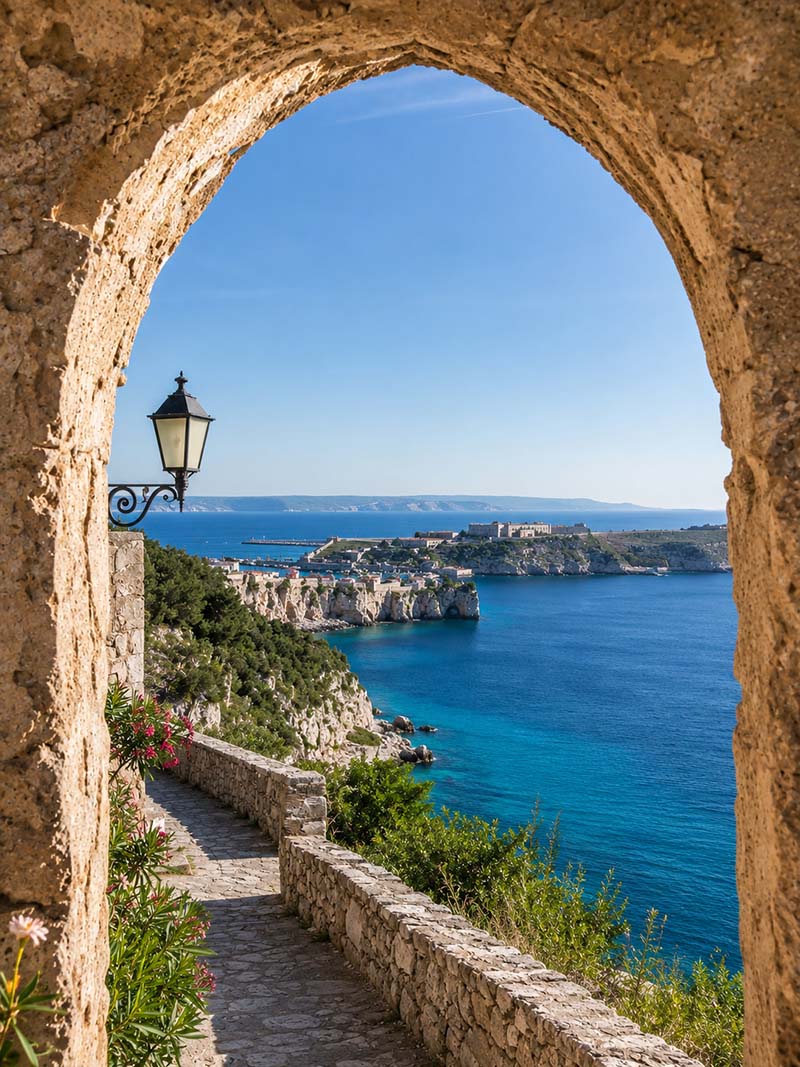
The Tremiti Islands are the only archipelago in the Adriatic, a handful of limestone islands some twenty kilometres off the Gargano coast. For centuries they were a place you were sent to, not a place you chose to go: monks, exiles, political prisoners. Today they’re a summer destination — but that history is still there underneath, and it changes how you look at them.
There are five islands, but only two are really visited: San Domino, the one with the forest and the beaches, and San Nicola, the one with the stone and the abbey. The other three — Capraia, Cretaccio, Pianosa — you see from the boat.
This guide is for understanding what you’re looking at before you set foot there.
What to See in the Tremiti, in the Right Order
1. The islands: what they are and how to get there
The archipelago is part of the Gargano National Park and is ringed by a marine reserve. San Domino is the largest and greenest; San Nicola is the historic and administrative centre, facing it, separated by a strait just a few hundred metres wide. Capraia (or Caprara), Cretaccio and the distant Pianosa are uninhabited.
You can only get there by sea. Year-round connections leave from Termoli, in Molise; in summer there are also departures from Vieste, Peschici, Rodi Garganico and other Gargano harbours, as well as from Abruzzo. A continuous shuttle boat runs between San Domino and San Nicola.
Important: on the islands a car is essentially useless and in summer is not allowed for visitors. You get around on foot or by shuttle.
2. San Domino: the forest and the sea
San Domino is covered by an Aleppo pine forest that reaches almost to the cliffs — a rare thing for such a small island. You walk it on shady paths that look out over the open sea.
Its only sandy beach is Cala delle Arene, small and crowded in high season. The rest of the coast is made of coves, cliffs and inlets reachable on foot or by boat: Cala dello Spido, Cala Matano, and the viewpoint of the Architiello, a natural rock arch.
San Domino is also where you sleep and eat: the hotels, the seafood restaurants and the archipelago’s evening life are almost all here.
3. The sea caves
The best way to see the Tremiti is from the water. The boat tour of the caves circles the islands and slips into the inlets you can’t see from land: the Grotta del Bue Marino, the largest, named after the monk seal that once lived there; the Grotta delle Viole, with its violet reflections; the rocks and arches carved out by the sea.
Boats leave San Domino harbour continuously through the season. It’s an hour and a half that’s worth the whole trip: the Tremiti coast seen from land and from the sea are two different places.
4. San Nicola: the monks’ island
If San Domino is nature, San Nicola is history. It’s a small, rocky island, almost without trees, but it’s here that the ancient heart of the archipelago beats.
At its centre stands the Abbey of Santa Maria a Mare, founded over a thousand years ago and for centuries the real power of the islands: Benedictine monks, then other orders, reclaimed the land, built and fortified. The abbey is a fortified complex, with walls, towers and a medieval floor mosaic inside the church. You can walk it in an hour, among alleys, stairways and views over the sea.
San Nicola is the place not to skip when someone tells you “the Tremiti are just beaches”. They aren’t.
5. The exile colony: paradise and prison
The Tremiti were long a place of confino — internal exile, where the state sent the people it wanted out of the way. It happened under the Bourbons and again under Fascism, when San Nicola and San Domino held political prisoners and other detainees.
It’s the paradox you feel the moment you arrive: the same beautiful sea that’s a holiday today was, for generations, the wall of a prison without bars. Knowing this history doesn’t spoil the place — it makes it truer. It’s hard to look at San Nicola the same way once you know.
6. The marine park: what lies beneath
Around the islands lies a marine reserve — among the first established in Italy — protecting some of the clearest seabeds in the Adriatic. It’s a paradise for snorkelling and diving: walls dropping sheer, submerged caves, meadows of posidonia seagrass.
Even without gear, the water is so clear that from a boat you can see the bottom several metres down. If you do one thing in the Tremiti besides walking, it’s putting your head underwater.
How Long You Need and When to Go
As a day trip: this is how most visitors see the Tremiti — morning ferry, San Domino, the cave tour, a stop on San Nicola, back in the evening. It works, but it’s a rush.
One or two nights: sleeping on San Domino is another thing entirely. When the day-trippers’ ferries leave, the island empties and falls silent. That’s when you understand why someone, here, stayed.
When: the season is essentially summer (June to September), when all the connections run and the sea is the main event. Off-season the islands are atmospheric but almost everything closes, and the ferries thin out.
What the Usual Guides Don’t Show
Lists tell you which the islands are and where to swim. They don’t tell you why an abbey ended up on a rock in the middle of the Adriatic, why these islands were a prison, why they’re called Tremiti — and what the Greek hero Diomedes, whom legend has buried here, has to do with it.
The Tremiti — The Forgotten Archipelago audio story is built on that why: it doesn’t list the islands, it tells them, as you cross them. Twenty-nine minutes that show you two different places within the same archipelago.
Frequently Asked Questions about the Tremiti Islands
How do you get to the Tremiti Islands?
Only by sea. Ferries and hydrofoils run year-round from Termoli (Molise) and, in summer, from Vieste, Peschici, Rodi Garganico and other Gargano harbours. The crossing takes from about an hour (hydrofoil) to a couple of hours (ferry), depending on the port.
How many days do you need for the Tremiti?
For San Domino, San Nicola and the cave tour, a full day is enough. To enjoy the islands once the day-trippers have left, stay one or two nights on San Domino.
San Domino or San Nicola?
They’re complementary. San Domino is nature, forest, beaches and evening life; San Nicola is history, the abbey and the quiet. A full visit includes both — they’re a few minutes apart by shuttle boat.
Can you visit the Tremiti as a day trip from the Gargano?
Yes. In summer daily excursions leave from Vieste and the other Gargano harbours. It’s the most common way to see them if you’re on holiday on the Gargano coast. See also what to see in Vieste.
Can you bring a car to the Tremiti?
In practice no, and in summer it isn’t allowed for visitors. You get around the islands on foot or by shuttle: San Domino is small, San Nicola is entirely pedestrian.
Sources and method
This article is written and reviewed by Localis. The project’s sources are collected on the Sources page. For the full editorial method see The Localis method.