Almost everyone knows Vieste from the photos: the white monolith on the beach, the turquoise sea, the lime-washed houses crowded on top of the promontory. The trouble is that photos show a postcard, and a postcard can’t be visited.
Vieste sits on the very tip of Italy’s spur — the easternmost point of the Gargano, where the coast stops being a coast and turns into a sheer cliff. Arrive knowing what you’re looking at and you understand why a town ended up perched up there, why the houses are white, why there’s an eighty-foot rock planted in the middle of the beach. Arrive just for the swim and you miss half of it.
This guide is for the half you’d otherwise miss.
What to See in Vieste, in the Right Order
1. The old town: the white village
The heart of Vieste is its medieval old town, perched on the promontory above the sea. The houses are lime-washed white — not for looks, but for an old practical reason: lime reflects the sun, keeps the inside cool and disinfects the walls. The result is a maze of white alleys, arches, and stairways that climb and drop with no obvious logic.
At the top you’ll find the Co-Cathedral of Santa Maria Assunta, Romanesque in origin and reworked many times, and the Swabian Castle, given its present shape in Frederick II’s era to watch over the coast. The castle today is partly military and not always open inside, but its position explains everything: from up there you command the whole gulf.
Getting around: start from the harbour, climb towards the Cathedral, then drop down the other side towards the Pizzomunno. You can cross the old town on foot in an hour if you keep walking, three if you keep stopping to look.
2. The Pizzomunno: the monolith and the legend
On Scialara beach, at the foot of the old town, stands a white sea stack about twenty-five metres tall: the Pizzomunno, the symbol of Vieste.
The legend is the one any local will tell you. Pizzomunno was a young fisherman in love with Cristalda. The sirens, jealous, wanted him for themselves; when he refused them they dragged Cristalda down to the bottom of the sea, and he turned to stone with grief. Tradition says that once every hundred years, on a single night, the two are reunited.
It’s a legend — but it’s also how a fishing town gave a name to its own grief, to the boats that never came back. Worth knowing before you stand in front of the rock: it changes what you see.
3. The trabucchi: fishing on the edge
Along the coast around Vieste you’ll see wooden structures reaching out over the sea, built from beams, winches and big square nets: these are the trabucchi, old fishing machines typical of the Gargano (and of the whole Adriatic coast up into Molise and Abruzzo).
They let fishermen work without putting out to sea: the net is lowered from the platform and catches the fish passing close to shore, riding the currents. Building and maintaining one took timber, effort and a deep knowledge of the sea — they were a family investment, handed down.
Many have now been restored, and some work as restaurants. They remain the most concrete trace of a relationship with the sea built on patience, not engines.
4. The beaches and the coves
Scialara beach (or Castle beach), the Pizzomunno one, is the most central: you can walk there straight from town. To the south open up San Lorenzo, the Bay of Pugnochiuso, the Bay of Campi — wider, better equipped, reachable by car.
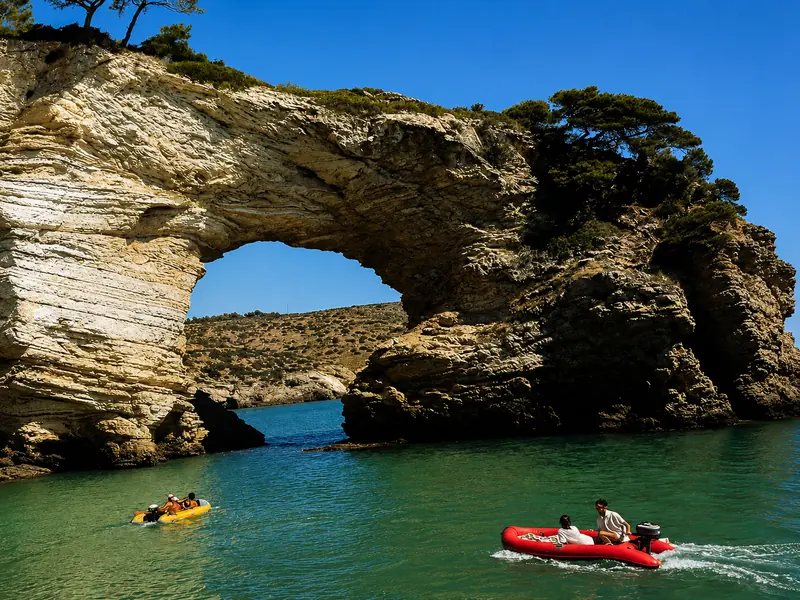
But the best of Vieste are the coves you can only reach by boat: narrow inlets between the cliffs, natural arches carved by the sea, caves. Cala San Felice with its Architiello — a natural rock arch — is one of the best known. To see them you need a boat trip from the harbour: in high season daily excursions run along the coast.
In short: if you just want a swim, Scialara is enough. If you want to understand the coast, take the boat.
5. How to find your way around Vieste
Vieste’s geography is simple once you see it from above:
- The harbour and marina sit on the north side of the promontory.
- The white old town is at the top, with Cathedral and Castle.
- The Pizzomunno and Scialara beach are on the south side, below the town.
- The big beaches (San Lorenzo, Pugnochiuso, Campi) stretch south along the coast.
- Punta San Francesco, at the far end, is the viewpoint where the promontory runs out into the sea.
Keep the ZTL (restricted traffic zone) in mind: the old town is closed to cars, and in summer the car is more of a problem than a convenience. Park in the areas outside the centre and move around on foot.
6. 1554: the Turks and the Chianca Amara
In July 1554 the fleet of the corsair Dragut (Turgut Reis), in the service of the Ottoman Empire, sacked Vieste. The able-bodied were taken and sold as slaves; those too old or too young to fetch a price on the market were killed.
In the old town, near the Cathedral, there is a large limestone slab that tradition calls the Chianca Amara — the “bitter stone”: it is the place where, according to the town’s memory, the executions took place. It’s an ordinary stone, until you know what it stands for. Then it’s the heaviest spot in all of Vieste.
The corsair raids explain a lot about the Gargano coast: why the towns sit high up, why there’s a watchtower every few kilometres, why for centuries the sea was a threat as much as a livelihood.
7. What to eat in Vieste
Seafood, above all: fresh fish, shellfish, the catch that still comes in from the trabucchi and the harbour boats. But the Gargano is also inland: caciocavallo podolico, the cheese made from Podolica cows grazing on the upland, and the citrus of the Gargano — its PGI oranges and lemons — are the counterpoint from the land.
Look for the simple dishes: spaghetti with sea urchins or mussels, grilled fish, orecchiette when you want to stay on the Puglia classic. The rule is the same as always: where the fishermen eat, you eat well.
How Long You Need and When to Go
One day: old town, Pizzomunno, one beach. The essentials, but in a rush.
Two or three days: add the boat trip to the coves, one of the big southern beaches, and the time to wander the alleys without hurrying. That’s the right amount to understand Vieste rather than treat it as a quick stop.
When: June and September are the best months — the sea is already (or still) good, but without August’s crowds and prices. In August Vieste is gorgeous and packed: factor that in.
What the Usual Guides Don’t Show
Maps and lists tell you where the things are. They don’t tell you why the town is white, why there’s a rock in the middle of the beach, what it meant to live on a coast that every summer might see the corsairs arrive.
The Vieste — The City on the Cliff audio story is built on that why: it doesn’t list the stops, it tells them, as you walk. Twenty-nine minutes that don’t replace the visit — they change it.
Frequently Asked Questions about Vieste
How many days do you need to visit Vieste?
A day is enough for the old town and the main beaches. To enjoy the coves by boat and the coast to the south (Pugnochiuso, San Lorenzo) as well, count on two or three days.
How do you get to Vieste?
Vieste has no railway station. You get there by car (from the A14, exit Poggio Imperiale or Foggia, then the Gargano state road) or by bus from the main Puglia cities. In summer there are sea connections. The nearest airports are Bari and Foggia.
Which is the best beach in Vieste?
It depends what you want. Scialara beach (the Pizzomunno one) is the most scenic and central. For more space and services there are San Lorenzo and Pugnochiuso, to the south. The most striking coves can only be reached by boat.
Vieste or Peschici?
They’re different. Vieste is larger, livelier and has a bigger old town; Peschici is smaller and more compact. For a first visit to the Gargano, Vieste offers more to see and a more convenient base.
Can you visit the Tremiti Islands from Vieste?
Yes. In high season ferries and hydrofoils leave Vieste harbour for the Tremiti Islands (San Domino and San Nicola). It’s a day trip: leave early and check the timetables, which change with the season.
Sources and method
This article is written and reviewed by Localis. The project’s sources are collected on the Sources page. For the full editorial method see The Localis method.