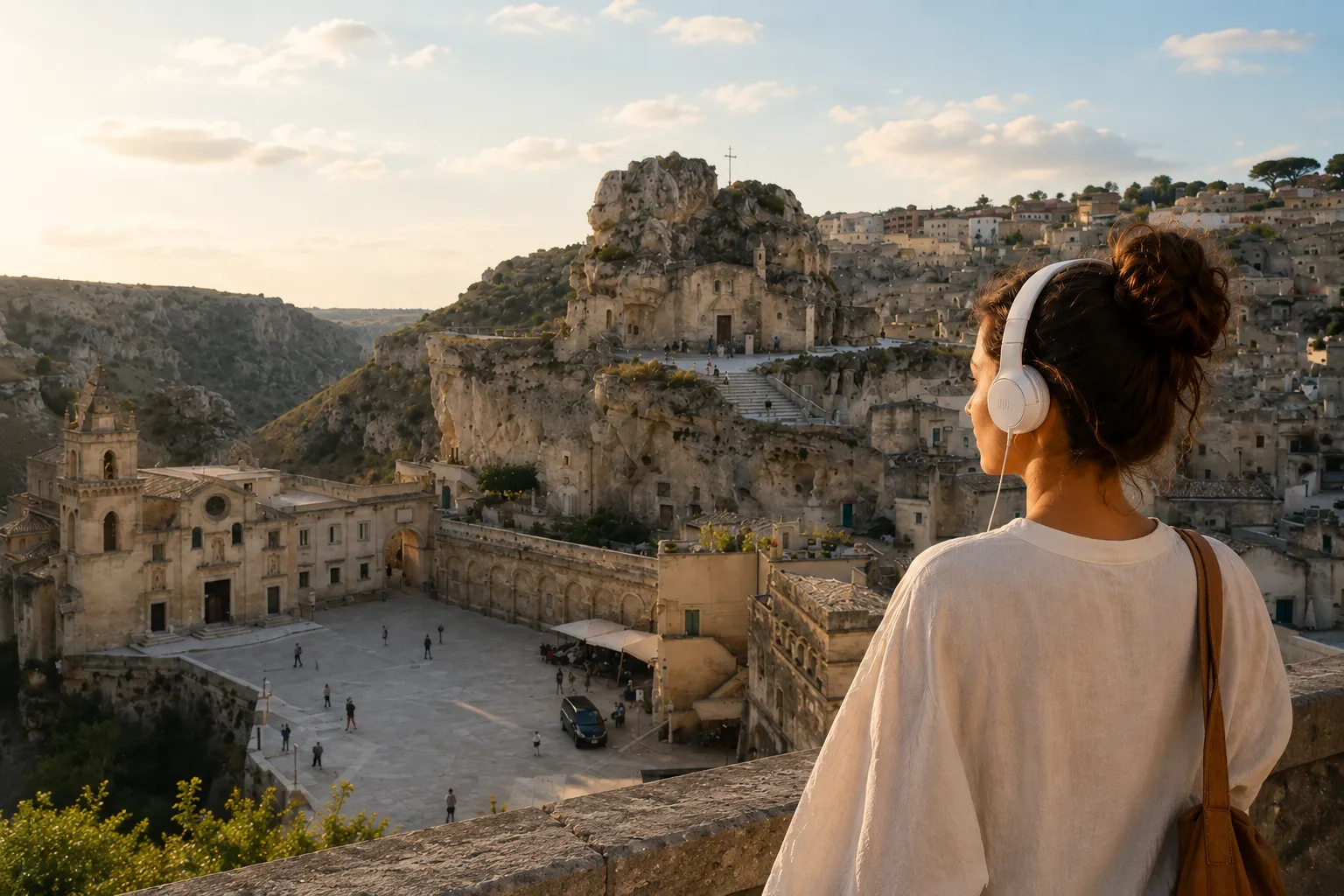
Matera is one of the most photographed cities in Italy, which is both its fortune and its misunderstanding. Because the Sassi aren’t a view: they’re a system where people lived for millennia by carving the rock, and until seventy years ago that life was still brutally hard. Arrive just for the sunset photo and you miss the story that makes Matera one of the most astonishing places in the Mediterranean.
This guide is for actually seeing it.
What to See in Matera, in the Right Order
1. What the Sassi are
The Sassi are two districts — Sasso Caveoso and Sasso Barisano — carved into the sides of a gravina, the canyon cut by the stream. They aren’t houses “with” a cave: they’re houses that are cave, enlarged and walled at the front over the centuries. Between the two Sassi rises the Civita, the rocky spur holding the ancient core of the city.
Seeing them from the viewpoints gives you the whole. But to understand them you have to go down inside, into alleys that are at once a street and the roof of the house below.
2. Water: the system that let Matera survive
The thing nobody photographs is the most ingenious. A city carved into rock, with no river, survived for millennia thanks to an extraordinary water-collection system: cisterns, channels, basins dug everywhere. The largest is the Palombaro Lungo, a vast underground cistern beneath Piazza Vittorio Veneto, as tall as a building.
Before being beautiful, Matera was clever: every drop of rain was collected and stored. That’s what made living in the rock possible.
3. Life in the Sassi and the “shame of Italy”
Into the 1950s, life in the Sassi was brutally hard: whole families in a single carved room, together with the animals, with very high infant mortality. In 1952 a state law ordered the evacuation of the Sassi: thousands of people were moved to new neighbourhoods, and the districts stood empty for decades.
It was called the “national shame”. Knowing this story changes everything: the Sassi that are hotels and restaurants today are the same houses the state was evacuating people from seventy years ago. The beauty and the wound are the same place.
4. The rock churches
Scattered through the Sassi and along the gravina are more than a hundred rock churches: places of worship carved into the stone, some with Byzantine and medieval frescoes still visible. They are the trace of an ancient religiosity, of monks and communities who chose the rock as the lay inhabitants did.
Don’t try to see them all: look at two or three with attention. Santa Maria de Idris and San Pietro Barisano are among the best known.
5. The Civita and the Duomo
At the top of the Civita stands the Duomo, the 13th-century Apulian-Romanesque cathedral, dominating both Sassi. From up there you grasp the city’s geography: the two districts dropping away on either side, the gravina in front, the Murgia beyond.
The Civita is also the oldest nucleus, the point from which Matera began before spreading into the Sassi.
6. The Murgia: the side nobody counts
On the other side of the gravina opens the Murgia Materana Park: a rocky plateau, more rock churches, and the viewpoint from which you see the whole of Matera, as the directors who set dozens of films here saw it. It’s the perspective that shows why the Sassi are exactly where they are.
You reach it on foot (paths through the gravina) or by car. It’s best at dawn or sunset.
How Long You Need and When to Go
One day: the two Sassi, the Palombaro, a rock church, the Duomo. Doable, with a lot of walking.
Two days: add the Murgia on the other side, more rock churches, and the time to lose yourself in the alleys — which is the right way to be in Matera.
When: spring and autumn are ideal. In summer the stone holds the heat and the shadeless alleys are tough at midday; in winter the light on the Sassi is beautiful but the days are short.
What the Usual Guides Don’t Show
Photos show the Sassi. They don’t show the water beneath your feet, the life that was brutally hard here, why the state evacuated an entire city, how Matera went from “shame of Italy” to UNESCO World Heritage and European Capital of Culture.
The Matera — The Sassi audio story is told by someone born in the Sassi: it doesn’t list the monuments, it makes you understand how people lived. Half an hour that changes what you see when you look up again.
Frequently Asked Questions about Matera
How many days do you need to visit Matera?
For the Sassi, the Palombaro Lungo, a rock church and the Duomo, a full day is enough. To add the Murgia and see Matera at a calm pace, two days is better.
Can you visit the Sassi for free?
Walking through the Sassi is free. The museum cave-houses, the main rock churches and the Palombaro Lungo charge a ticket. Several sites can be visited on a single combined entry: check on the spot.
How do you get around the Sassi?
On foot only, with lots of stairs and changes in level. Comfortable shoes are essential. The Sassi aren’t accessible by car and largely not by pram or wheelchair.
Which is the best viewpoint?
To photograph the Sassi from above, the belvederes within the city. To see the whole of Matera face on, the Murgia viewpoint, on the other side of the gravina.
Is Matera in Puglia?
No: Matera is in Basilicata, but it’s right by the Puglia border and is often visited together with Puglia. From Bari it’s about an hour away.
Sources and method
This article is written and reviewed by Localis. The project’s sources are collected on the Sources page. For the full editorial method see The Localis method.