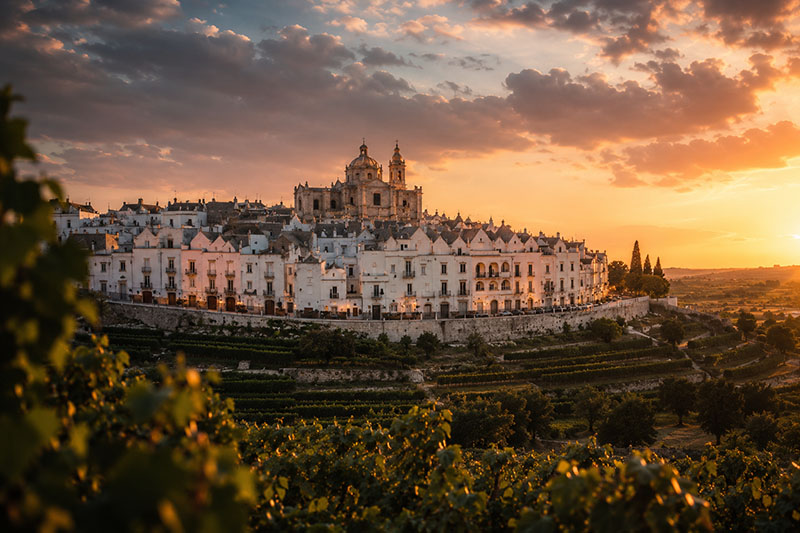
Locorotondo is one of those towns you only understand by looking at the map: the old town is round, built in concentric circles on a hill. The name says it — Locus Rotundus — and walking inside it is unlike any other town in the Itria Valley: you turn, and sooner or later you’re back where you started. It’s small, white, and has one detail that sets it apart from Alberobello: here the roofs aren’t cones, they’re pointed.
This guide is for reading the round village.
What to See in Locorotondo, in the Right Order
1. The town that goes in circles
The old town is the thing to see: a circular maze of white alleys following the shape of the hill. There’s no grid square, no straight axes — there’s a ring that wraps around itself. Step in and walk without a map: in Locorotondo getting lost is impossible, because every street eventually loops back.
It’s one of “the most beautiful villages in Italy”, and here the title is deserved: the very shape of the town is the monument.
2. The cummerse: not trulli
The detail that sets Locorotondo apart is the roof. The houses in the centre have cummerse: pointed, pitched roofs covered in stone slabs, completely different from the cones of Alberobello’s trulli. They were made to drain rainwater quickly and collect it in cisterns.
Confusing cummerse with trulli is the classic mistake. Knowing the difference is the best way to look at the Itria Valley with new eyes.
3. San Giorgio and the square
The neoclassical Mother Church of San Giorgio dominates the town with its dome: it’s the landmark the centre turns around. The square in front is the heart of town life, where you sit and watch the evening go by.
4. The wine: Verdeca and Bianco d’Alessano
Locorotondo is white-wine country. The hills around are covered with vineyards of Verdeca and Bianco d’Alessano, the grapes of the Locorotondo DOC. The cooperative winery, active since the 1930s, is one of the town’s institutions and tells a story of collective farming more than of single estates.
A glass of the local white, cold, is the right way to end the visit.
5. The balcony of the Itria Valley
From the edge of town — especially from the Villa Comunale (public garden) — opens the panorama over the Itria Valley: a rolling expanse of vineyards, olive trees, dry-stone walls and trulli scattered to the horizon. It’s one of the best spots to grasp the geography of the whole valley at a glance.
How Long You Need and When to Go
An hour or two is enough for the old town, San Giorgio and the view. Locorotondo is a short stop, perfect to combine with Alberobello and Ostuni in a day of the Itria Valley.
When: late afternoon is the best time — the light on the white, the golden panorama, an aperitivo in the square. In summer the evenings are lively; off-season the town is quiet and all yours.
What the Usual Guides Don’t Show
Photos show the white alleys. They don’t tell you why the town is round, why the roofs are pointed and not conical, what wine has to do with the town’s history, how to read the Itria Valley from its balcony.
The Locorotondo — The Round Village audio story tells exactly this: the shape, the stone, the vineyard. Half an hour that turns a quick stroll into a reading of the place.
Frequently Asked Questions about Locorotondo
How long do you need to visit Locorotondo?
An hour or two is enough for the old town and the view. It’s a short stop, ideal to combine with the other towns of the Itria Valley.
What’s the difference between cummerse and trulli?
Cummerse are houses with pointed, pitched roofs, typical of Locorotondo; trulli have conical roofs, typical of Alberobello. They’re two different building traditions of the same area.
Why is Locorotondo called that?
From the Latin Locus Rotundus, “round place”: the old town is built in concentric circles on the top of the hill, hence the circular plan.
What do you drink in Locorotondo?
The local white wine, mainly from Verdeca and Bianco d’Alessano grapes (Locorotondo DOC). The town’s cooperative winery is historic.
What to see near Locorotondo?
The other towns of the Itria Valley: Alberobello and the trulli, Ostuni the white city, Cisternino, Martina Franca. They’re all a few kilometres away.
Sources and method
This article is written and reviewed by Localis. The project’s sources are collected on the Sources page. For the full editorial method see The Localis method.