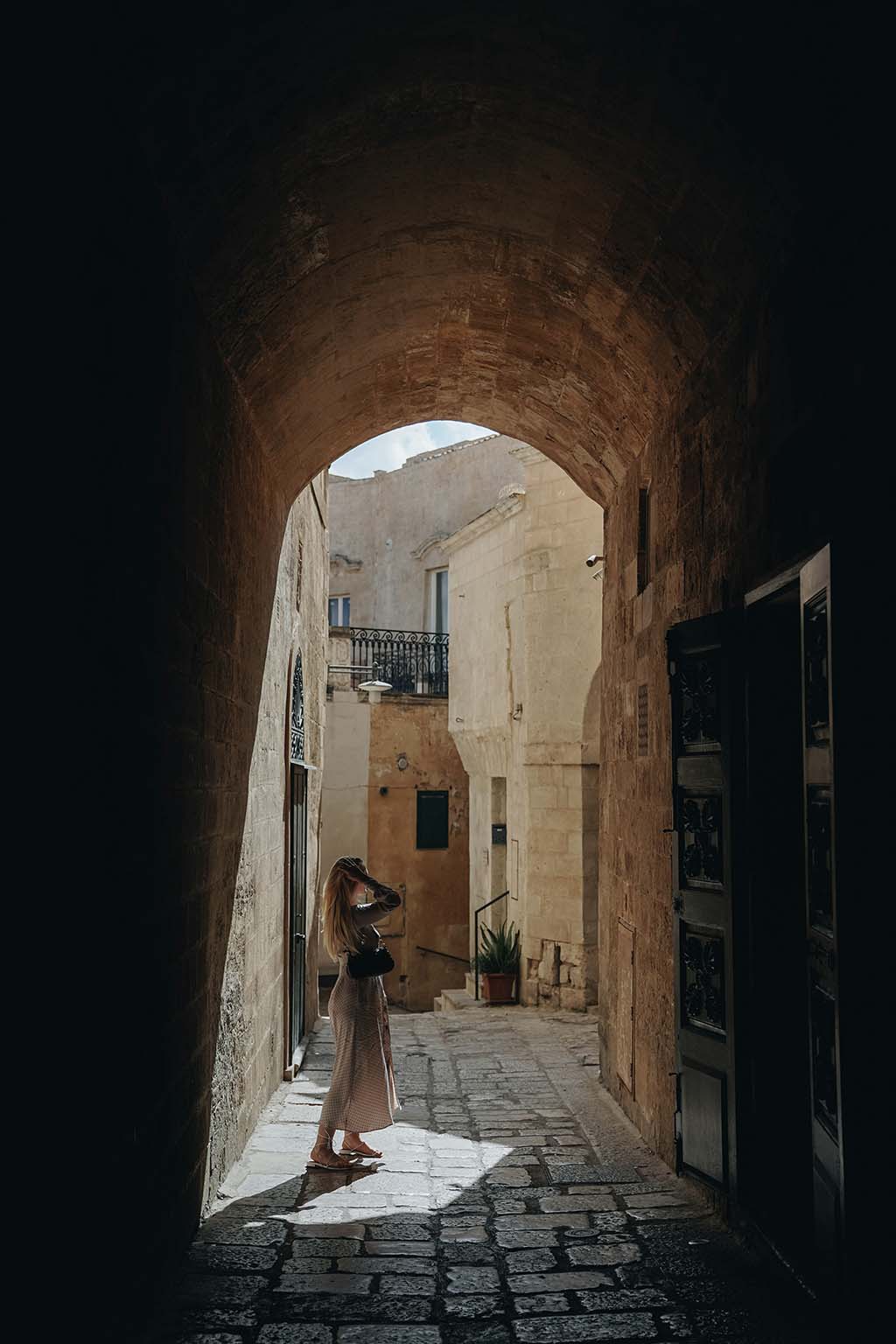
Bari old town is one square kilometre. In theory, two hours are enough to walk across it. In practice, if you arrive without knowing what you’re looking at, you leave with the feeling of having seen a lot of stones without understanding a single one. If you arrive knowing — or with someone telling you the story — you leave feeling you’ve visited five different cities stacked on top of each other in the same space.
This guide is for the second kind of visit.
First thing: stop looking for the way out
Bari old town is built to confuse you. The alleys narrow, change direction without warning, end in closed courtyards or open onto little squares that don’t exist on any map. It isn’t a planning flaw — it’s a medieval defensive system: anyone who doesn’t know the quarter gets lost, and that was exactly the point.
As soon as you step in, give yourself twenty minutes with no particular destination. Wander, take wrong turns, end up in a dead end. This is the right way to begin.
What to see, in the right order
1. The Basilica of San Nicola
The Basilica of San Nicola is the reason Bari is known across the entire Christian world. The relics of the bishop of Myra arrived here in 1087 — carried off from Myra by sailors from Bari, in what medieval sources call a translation and modern historians call a holy theft — and ever since, the Basilica has been a place of pilgrimage for Orthodox, Catholics, Russians, Greeks and Serbs.
Begun that same year, 1087, and consecrated in 1197, the Basilica is one of the most complete examples of the Apulian Romanesque: a broad, compact façade, two side towers that seem to stand guard rather than reach upward, three portals, and a decorative restraint that is the opposite of the Gothic but no less striking.
Don’t skip: the crypt, where the relics are kept. Go down: that’s where the Basilica reveals why it exists. And look at the Orthodox chapel in the left transept — it’s one of the rare examples in Italy of Catholic-Orthodox coexistence crystallised in architecture.
Suggested time: 45–60 minutes.
To really understand: the story of San Nicola in Bari — the full picture of the saint, the theft and the Basilica.
2. The street of the orecchiette
Even before you reach a restaurant, look for Via dell’Arco Basso and the little streets around the Cathedral: this is where a few women make orecchiette by hand in front of their doorways. The gesture is quick — a knife dragging the dough across the wood, the pasta curling up — and it comes from years of daily practice.
It isn’t a tourist demonstration. It’s work. The orecchiette you see are sold right there or end up in the restaurants of the quarter. Stop, watch, buy a bag if you feel like it.
To really understand: orecchiette in Bari old town — the history, the technique and the three traditional sauces.
3. The Cathedral of San Sabino
Five minutes from the Basilica, the Cathedral of San Sabino is the historic cathedral of Bari — the one that, technically, is the bishop’s seat. It’s almost always overlooked by the tourists who stop at San Nicola, and that makes it, paradoxically, the quietest and most contemplative place in all of Bari old town.
The Cathedral was built in the 12th century, on earlier structures. The exterior is sober Romanesque; the interior preserves medieval elements, with parts of the original crypt. If San Nicola is the basilica of international pilgrimage, San Sabino is the city’s own church — the one that has baptised, married and buried the people of Bari for centuries.
Suggested time: 20–30 minutes.
4. The Norman-Swabian Castle
The Castle can be seen from outside Bari old town, on the north side towards the sea. The structure as it stands today is largely the result of the expansion ordered by Frederick II of Swabia between 1233 and 1240: the four corner towers, the trapezoidal inner courtyard, the moat that originally reached the sea.
Frederick built throughout southern Italy with a care his successors never matched. The castle of Bari was meant to watch over the harbour and control access to the old town — but it was also meant to impress. It still manages to.
Inside, the National Museum houses a collection of casts of medieval Apulian sculpture — useful if you want to understand the Romanesque iconography you’ve just seen in the Basilica.
Suggested time: 30 minutes outside, 45–60 with the museum.
5. Piazza Mercantile and Piazza del Ferrarese
The two squares on the border between Bari old town and the seafront are the transition point between the medieval quarter and the modern city.
Piazza Mercantile — with its eighteenth-century Palazzo dell’Arrendamento and the Column of Justice — was the commercial heart of the medieval and early-modern city. Piazza del Ferrarese opens straight onto the seafront and marks the eastern edge of the quarter.
Here the fabric changes: the narrow alleys give way to cafés with tables outside, the sea comes into view, people sit on benches. They’re the right place to pause before deciding the next move.
6. The alleys and the courtyards
Between one stop and the next: walk with no aim. Bari old town has one of the highest housing densities in southern Italy — around 17,000 people in a single square kilometre. It isn’t a hollowed-out historic centre: real people live here, with the washing strung between balconies, children playing in the courtyards, the old folk sitting on chairs outside their doors.
The blind courtyards — small enclosed spaces reached only through a single narrow entrance — are the most distinctive microstructure of the quarter. In medieval times they were defensive; today they’re often the semi-private spaces shared by the families living in the apartments around them.
You can step into a courtyard without disturbing the residents: most are accessible and the people who live there are used to visitors. With respect.
How much time you need to visit Bari old town
Quick visit (2 hours): Basilica of San Nicola + Cathedral + a walk through the alleys. It covers the essentials but leaves almost everything out.
Full visit (4–5 hours): everything above, including the Castle and the seafront squares. Time to stop for orecchiette and to get a little lost.
With the audio stories: the Localis stories on Bari old town and San Nicola run 31 and about 30 minutes of narration respectively, but the listening pace in the real city is slower — count on 4–5 hours overall for both.
Practical tips
Basilica of San Nicola hours: open every day, morning and afternoon (check the official site for up-to-date hours and special liturgies).
Castle hours: generally open in the morning and early afternoon; Wednesday afternoon and Thursday morning may close for events. Check first.
Morning or afternoon? The morning (9–11) is livelier — the women are making orecchiette, the little markets are busy. In the afternoon the light on the limestone is beautiful, but some shops are shut after lunch.
With children? The narrowest alleys aren’t passable with a standard pushchair. Bring a carrier or a compact folding stroller. The Basilica and the Castle are accessible.
What the traditional guides don’t show
Printed guides and organised tours cover the main buildings well. What they don’t show is the deeper logic of the quarter — why the alleys are so narrow, why there are blind courtyards, what it meant to live here in the Norman period, why San Nicola is also the patron saint of Moscow.
The Old Bari — Inside the City audio story is built on that logic: it doesn’t list the stops, it tells them. Thirty minutes that don’t replace the visit — they change it while you make it.
Frequently asked questions about Bari old town
Is Bari old town safe?
Yes. The quarter is busy with tourists and has a normal presence of residents and shopkeepers. As in any crowded historic centre, keep an eye on your pockets in the busiest moments.
Can you park near Bari old town?
Car access is restricted. The most convenient car parks are in the harbour area or on Via Nazario Sauro, along the seafront. From there the quarter is less than ten minutes away on foot.
How much does it cost to enter the Basilica of San Nicola?
The Basilica is free to enter. The crypt is accessible without a ticket. Some temporary exhibitions may ask for a contribution — check at the time of your visit.
Is there a better place to enter Bari old town from?
Entering from Piazza del Ferrarese or the seafront drops you straight into the heart of the quarter. Entering from the Castle side lets you see the outer defensive structure first. For a first visit, I’d suggest the seafront: the contrast between the openness of the sea and the immediate closeness of the alleys is the best way to grasp how the quarter is built.
Does Bari old town have a nightlife?
Yes. In the evening, especially in summer, Piazza Mercantile and the areas around it come alive with bars, music and people. It’s a different city from the one you see at dawn — worth coming back for.
Sources and method
This article is written and reviewed by Localis. For the history of Bari old town, see The History of Old Bari. The project’s sources are collected on the Sources page. For the full editorial method see The Localis method.