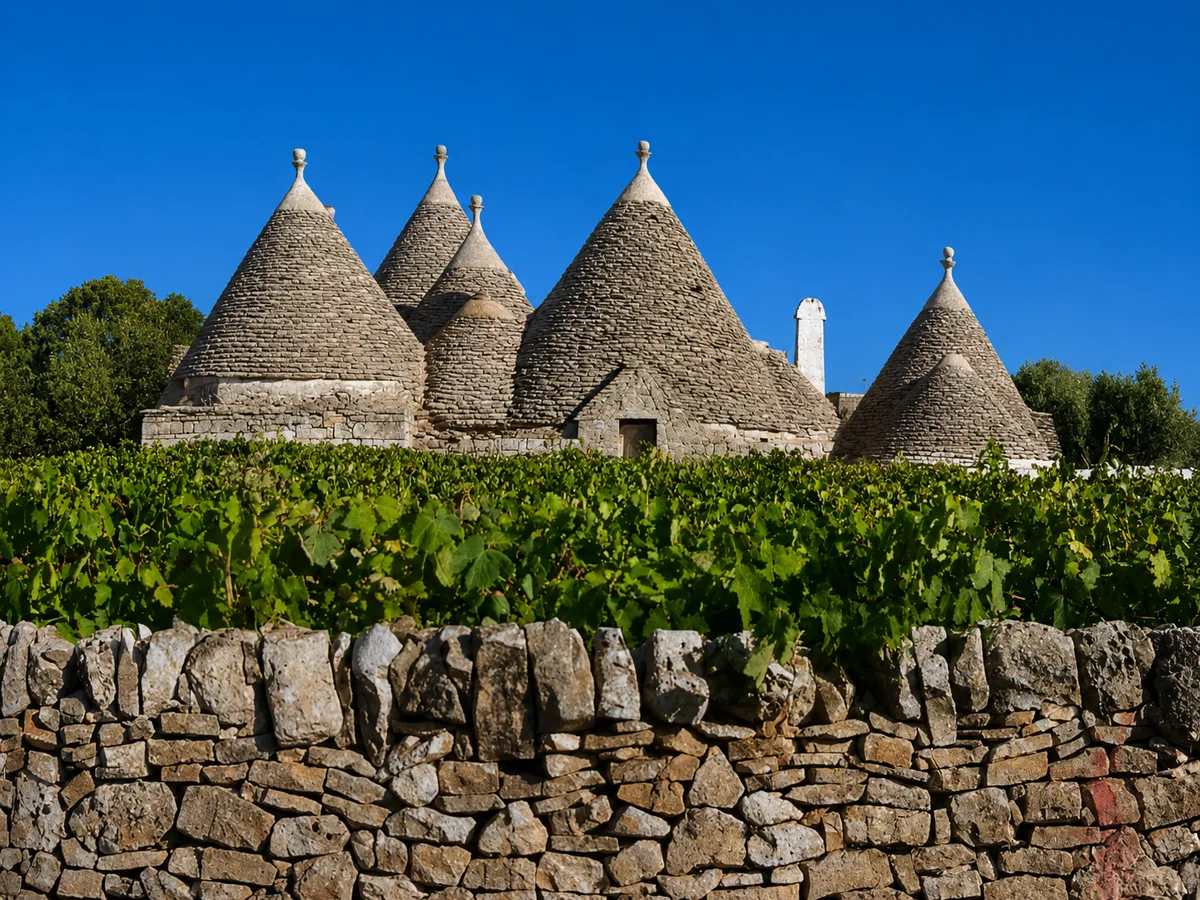
Trulli are the most photographed symbol of Puglia in the world: those white houses with grey conical stone roofs that rise among the vineyards and olive groves of the Itria Valley. But behind the postcard there’s a fact that leaves you stunned when you discover it: not a single drop of cement holds them up.
Every stone in those domes is wedged in by hand, dry. And it’s in that detail — no mortar — that the most interesting story hides.
What trulli are
The trullo is a traditional rural building in dry stone, with a white base and a grey cone-shaped roof. It’s typical of the Itria Valley, the area on the border between the provinces of Bari, Brindisi and Taranto, which includes Alberobello, Locorotondo, Cisternino, Martina Franca and Fasano.
They began as farm shelters and peasant dwellings, built with the limestone gathered when clearing the fields to make them workable. In other words: the raw material was already there, scattered across the land, and had to be removed anyway.
How they’re built: dry stone, without mortar
The feature that makes trulli unique is the building technique: dry stone, that is, without mortar binding the stones.
The cone roof is a false dome: rings of stones growing ever narrower as they rise, until they close at the top. The covering is made of thin limestone slabs called chiancarelle, overlapped like scales so the rainwater slides off. The walls are thick, lime-washed on the outside; inside it stays cool in summer and holds the warmth in winter.
It’s a poor and ingenious architecture: all based on balance and interlocking, with no binders. Building it took expert hands and a knowledge passed down from generation to generation.
The pinnacle and the symbols on the roofs
At the top of each cone sits the pinnacle, the decorative element that closes the dome: spheres, discs, cones, different shapes depending on the master builder who signed it.
On some roofs, in Alberobello, you’ll see symbols painted in lime: crosses, hearts, religious or propitiatory signs. They’re decorations of debated meaning — magical, religious, superstitious — that add a touch of mystery to an already extraordinary architecture.
Why without mortar: the tax legend
Here’s the story everyone tells in the Itria Valley. Tradition holds that the trulli were built dry precisely so they could be dismantled quickly: in the time of the Kingdom of Naples, an “unfinished” or easily demolished house could escape taxes on new buildings. Pull out the keystone and the trullo collapsed, becoming a heap of stones again: no house, no tax.
It’s a fascinating tale, and part of the place’s identity — but historians consider it largely legend. Alongside it remains the more practical, likely explanation: dry stone was the cheapest, most available technique, made with the material the fields offered for free. As so often, the truth lies between necessity and peasant cunning.
Alberobello and beyond: where to see trulli
Alberobello is the capital of the trulli: its Monti and Aia Piccola districts, with over a thousand trulli in rows, have been a UNESCO World Heritage Site since 1996. It’s where you see the most spectacular concentration — and rightly the best-known stop.
But trulli aren’t only Alberobello. They’re scattered across the whole countryside of the Itria Valley: standing alone among the vineyards, along the dry-stone walls, around Locorotondo, Cisternino, Martina Franca and Fasano. Often the finest trullo is the solitary one in the middle of a field, with no crowd around it. It’s worth seeing both faces: the concentration of Alberobello and the scattering of the countryside.
Sleeping in a trullo
Many country trulli have been restored and today work as holiday homes and agriturismi. Sleeping in a trullo is one of the most atmospheric ways to experience the Itria Valley: thick stone walls, cone-shaped ceilings, natural cool in summer. An experience that turns a symbol to photograph into a place to actually stay.
What the usual guides don’t show you
Guides tell you trulli are beautiful and that Alberobello is UNESCO. They don’t explain how they stand up without cement, why they were built this way, what they meant to the peasants who lived in them.
The audio story Alberobello — Inside the Trulli tells exactly this: the technique, the history and the life inside the trulli, not just their shape. It doesn’t replace the visit — it makes you understand what you’re looking at.
Frequently asked questions about trulli
How do trulli stand up without mortar?
The cone roof is a false dome: rings of stones growing narrower towards the top, held together by interlocking and weight, with no binders. The roof slabs, the chiancarelle, are overlapped so the rain slides off.
Why were trulli built without mortar?
Tradition says dry construction let them be dismantled quickly to escape taxes on new houses in the Kingdom of Naples. Historians consider this largely legend: the likelier reason is that dry stone was the cheapest technique, using material already available in the fields.
Where are trulli found in Puglia?
Trulli are typical of the Itria Valley, between the provinces of Bari, Brindisi and Taranto. The most famous concentration is in Alberobello (a UNESCO site), but they’re scattered across the countryside around Locorotondo, Cisternino, Martina Franca and Fasano.
What is the pinnacle of a trullo?
It’s the decorative element that closes the top of the cone — spheres, discs, cones — whose shape varied with the master builder. Some also carried a symbolic value.
Can you sleep in a trullo?
Yes. Many country trulli have been restored as holiday homes and agriturismi. It’s one of the most characteristic ways to stay in the Itria Valley.
Sources and method
This article is written and reviewed by Localis. The project’s sources are collected on the Sources page. For the full editorial method, see The Localis method.