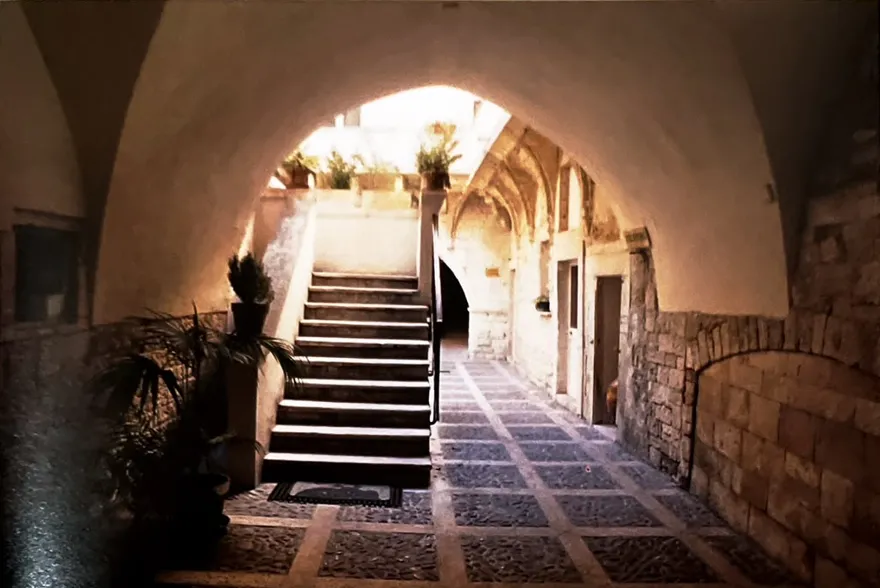
Old Bari is a limestone headland jutting out into the Adriatic Sea. About a square kilometre of alleys, arches, dead-end courtyards and churches carved into the rock — a labyrinth that took in, in this order, the Iapygians, the Romans, the Lombards, the Byzantines, the Normans, the Swabians, the Aragonese and the Spanish. Each people left a layer. The modern city built on top, erasing almost nothing.
This article gives you the historical picture to find your bearings before visiting Old Bari. The Localis audio story does something else: it doesn’t list monuments, it helps you read the city as you walk through it. Seeing is easy. Understanding is another matter.
Before Rome: Barium and the pre-Roman origins
The headland was already inhabited in the Bronze Age. The Iapygians — a people of Illyrian origin who occupied central and southern Puglia — founded a permanent settlement here. The Greeks called it Barium, a name that would survive everything: invasions, collapses, rebuildings.
The Romans took the city in the 3rd century BC and made the most of its harbour position: Barium was one of the Adriatic hubs of the Via Traiana, the consular road that ran from Benevento to Brundisium, today’s Brindisi. Where the Lungomare Imperatore Augusto now faces the sea, two thousand years ago ships were unloading grain, oil and ceramics bound for the capital.
The Catepanate: four centuries of Byzantium
The most enduring mark on Old Bari is neither Greek nor Roman, it is Byzantine. From the 6th to the 11th century, the city was the seat of the Catepanate of Italy — the westernmost outpost of the Eastern Roman Empire, with a military governor, the catepan, who answered directly to Constantinople.
Four centuries are enough to shape a city to its core. The current urban fabric preserves that logic: alleys that suddenly narrow, blind turns, inner courtyards reachable only through a hidden passage. The traditional explanation is the sea wind. The historical one is defence: a chase down those alleys quickly becomes suicide for anyone who doesn’t know them by heart.
During the Byzantine period, Bari was also an important ecclesiastical centre: the Greek church kept episcopal sees here, and the liturgical calendar followed the Eastern rite. Some churches in the old town still preserve apses oriented according to that tradition.
The Normans and the case of Robert Guiscard
In 1071, Robert Guiscard — the Norman duke of Puglia and Calabria — put an end to four centuries of Byzantine rule after a three-year siege. Bari was the last eastern stronghold in southern Italy; its fall marked the end of Byzantine Italy.
The Normans did not raze the city. They absorbed it, reorganised it, built in it. Robert left the Palace of the Catepan standing — it would serve his successors — and began work on the first defensive structures that, two centuries later, would become the castle.
The Basilica of Saint Nicholas: 1087
Sixteen years after the Norman conquest, in 1087, a group of Bari sailors — the sources speak of sixty-two men — returned from Myra (the coast of present-day Turkey) with the relics of Saint Nicholas, the 4th-century bishop venerated as the protector of sailors, children and merchants.
The operation can be read two ways. The people of Bari call it a translation. Modern historians call it a sacred theft, furtum sacrum — a common practice in the Middle Ages, in which seizing a saint’s relics meant securing his protection over the city.
The Basilica of Saint Nicholas was built starting that same year, 1087, on the foundations of the catepan’s palace. The work site lasted nearly two centuries. The result is one of the most intact Romanesque complexes in the South of Italy: three naves, a deep crypt where the relics rest, a painted timber truss ceiling that conceals the stone structure. The façade, of an almost military plainness, is decorated with two towers that end not in spires but in crenellated terraces.
Saint Nicholas is the reason Bari has been a pilgrimage destination for nine hundred years. Russians, Greeks, Serbs and Bulgarians still come today for the relics — the basilica houses an Orthodox chapel in the left transept, the only case in Italy of medieval ecumenism crystallised in architecture.
Frederick II and the Swabian castle
The Norman-Swabian Castle you see entering the old town from the north side is largely the work of Frederick II of Swabia, Holy Roman Emperor, who between 1233 and 1240 turned the Norman fortress into an imperial residence.
Frederick had a long relationship with southern Italy: he was born there (in Jesi, though raised in Sicily), he administered it better than any of his other possessions, and he built castles there with a care that in Germany he reserved for very few. The Bari castle was meant to guard the harbour and control access to the old town; but it was also meant to impress.
The present structure preserves the four corner towers added by Frederick, an inner courtyard with a trapezoidal plan, and a moat that was originally connected to the sea. The castle today houses the National Museum of Bari, with a collection of casts of medieval Puglian sculptures.
The Aragonese and the Spanish: the city closes in on itself
From the 15th to the 18th century, Old Bari lived first under Aragonese rule, then Spanish. These were centuries of consolidation rather than transformation: the street network stayed medieval, churches were enlarged or given a Baroque overlay, the noble families of Bari built palaces in the few open spaces.
The modern city — Murat’s Bari, with the regular street grid designed under Joachim Murat at the start of the 19th century — was built alongside the old town, not on top of it. This geographical separation preserved Old Bari: no 19th-century bulldozer, no 20th-century building speculation. The alleys are still here because they were already set apart.
How to visit Old Bari once you’ve understood its history
Anyone looking for what to see in Old Bari almost always finds the same names: the Swabian Castle, the Basilica of Saint Nicholas, the Cathedral of San Sabino, Piazza Mercantile, the city wall and the orecchiette alleys. They are essential places, but on their own they aren’t enough to explain why the old town of Bari is different from a simple ancient quarter.
To visit Old Bari on foot it helps to hold two levels together: the visible one, made of churches, white stone, arches and courtyards; and the less immediate one, made of dominations, sea routes, devotions, families, daily work. It’s on this second level that the city becomes understandable.
That’s why the Old Bari audio story isn’t conceived as a classic tourist guide. It’s a story to listen to as you walk, designed to turn what’s in front of your eyes into a story you can recognise.
Old Bari today
The old town has around 17,000 inhabitants — one of the highest densities in the South of Italy. It is not a museum: it’s a city that works. The women sitting in front of their doorways pulling pasta by hand are not a tourist performance; they’ve worked this way for decades, and probably will keep on doing so.
Tourism arrived, especially after 2015, with a sharp acceleration after the pandemic. It has brought something good (renovations, new venues, media attention) and something less so: rising rents, pressure on the families who have lived in the old town for generations, the usual jams of tour groups with earphones.
The best way to visit Old Bari is still on foot, slowly, ideally with no fixed itinerary — or with an audio story that leaves room to wander off course.
Frequently asked questions about visiting Old Bari
How much time do you need to visit Old Bari?
For a first visit to Old Bari, allow at least an hour and a half. If you want to step inside the Basilica of Saint Nicholas, stop on the city wall and walk the alleys without rushing, two hours is a more realistic measure.
Is Old Bari easy to visit on foot?
Yes. Old Bari is best visited on foot: the distances are short, but the old town is packed with passages, turns and courtyards. Comfortable shoes and a charged phone are all you need for a self-guided visit.
What should you see in Old Bari on a first visit?
The essential places are the Swabian Castle, the Basilica of Saint Nicholas, the Cathedral of San Sabino, the city wall, Piazza Mercantile and the inner alleys. But the most interesting part is understanding how these places fit together: harbour, faith, defence, trade and daily life.
What’s the point of an audio story about Old Bari if I’ve already read the history?
An article prepares you. A narrative audio story goes with you while you’re there, at walking pace, with the streets in front of your eyes. Localis doesn’t replace your gaze: it trains it.
Sources and method
This article was written and reviewed by Localis from the same editorial base used for the audio stories: historical research, verifiable sources and on-site visits. The selection is for the general reader: it doesn’t replace an academic bibliography, but it sets out the essential coordinates for understanding Old Bari before your visit.
The project’s main sources on Old Bari are collected on the Sources page and in the dedicated entry for the Old Bari — Inside the City guide. For the full editorial method see The Localis method.