The Three Theatres — Fire, Music and Bourgeoisie
Eighteen minutes, thirteen chapters, three theatres in half a kilometre.
How to listen
You can listen freely, or, where indicated, begin from the suggested starting point and walk through the place as the story unfolds. Localis is not turn-by-turn navigation: use your phone map to find your way.
- Runtime
- 27 min, 13 chapters
- Access
- After purchase, you receive an immediate link. Stream it or save it for offline listening before you begin.
- Languages
- Shown for each story
Guide facts
- Number of stops
- 13 audio stories
- Route
- Self-paced walking route
- Accessibility
- Historic center with mixed paving. Suitable for most visitors.
- What you need
- Headphones and a charged phone.
Chapters
- 01 Introduction 0:00
- 02 Murat — The new district 1:34
- 03 Piccinni 1854 — The first 3:49
- 04 The bourgeoisie that wanted opera 6:22
- 05 The Petruzzelli brothers 8:40
- 06 The Petruzzelli — Construction 10:49
- 07 The monopoly 13:03
- 08 Margherita — The trick on the sea 14:53
- 09 Eighty-eight years of glory 16:58
- 10 October 27, 1991 18:38
- 11 The eighteen years of emptiness 21:07
- 12 December 4, 2009 — The rebirth 23:40
- 13 Closing 25:55
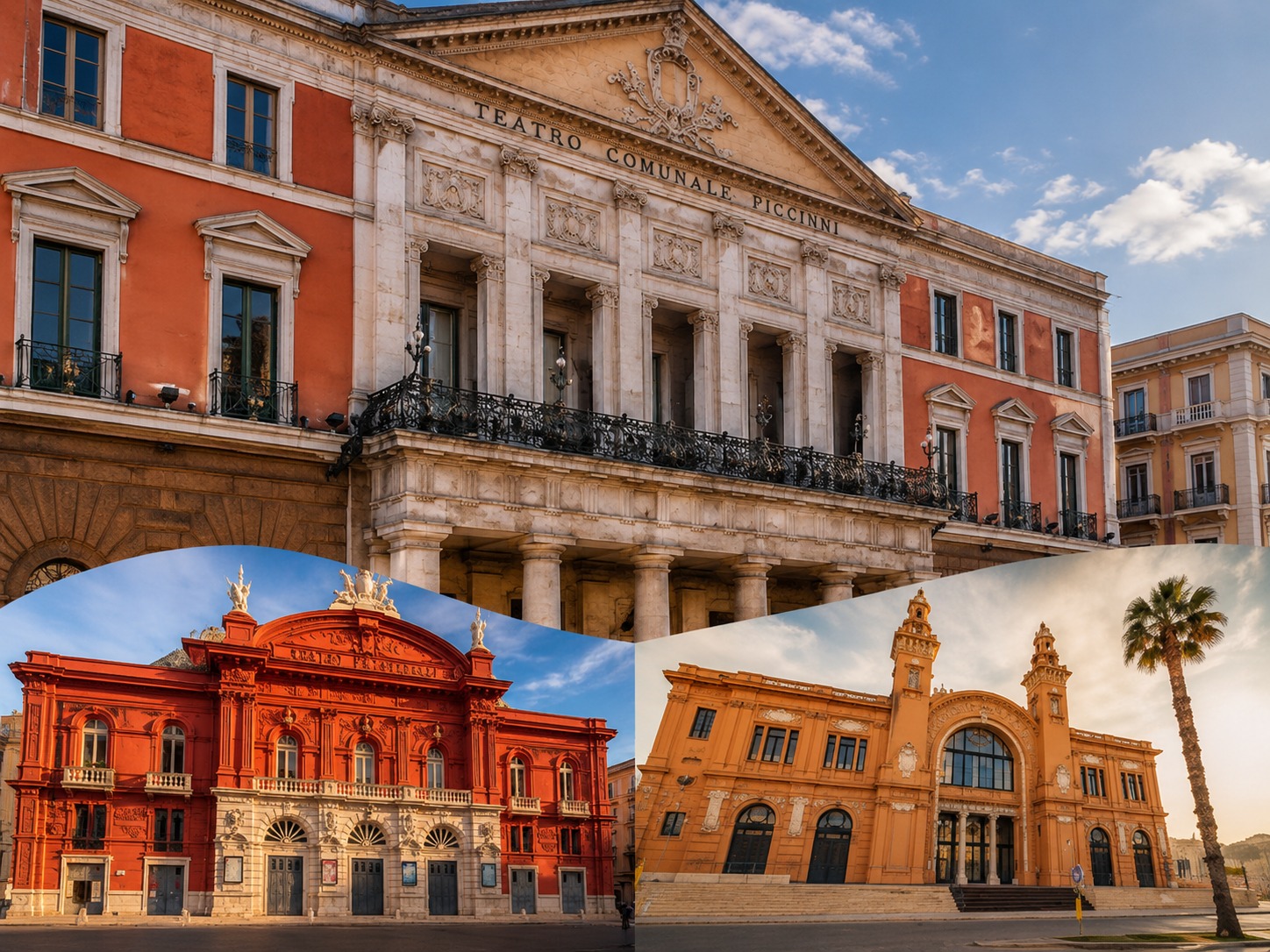
The Three Theatres: the story of the neighbourhood Bari built to look European
Not architecture: ambition. Why a southern Italian city in the nineteenth century built three theatres in half a kilometre.
Three theatres in half a kilometre. Almost no one knows why.
Every day hundreds of people cross the Murat district passing in front of the Piccinni, the Petruzzelli, the Margherita. Those who know them see them as monuments. Those who don't photograph them without understanding what all three are doing in the same half square kilometre of a southern Italian city in the nineteenth century.
It is not a coincidence and it is not a whim: it is a story of class, money and bourgeois ambition. The Bari bourgeoisie of the nineteenth century had decided that culture was defence — defence against perceived backwardness, geographical marginality, the unfavourable comparison with Naples and Milan. And it built its theatres as manifestos. This audio guide tells that story.
Thirteen chapters from 1854 to 2009
What makes this story different from an architectural guide? The fact that it covers a hundred and fifty years of city history through three buildings. You will meet the Petruzzelli brothers, two Armenian impresarios who arrived in Bari at the end of the nineteenth century, and learn how they built the fourth-largest theatre in Italy in three years. You will reconstruct the night of 26–27 October 1991 when the Petruzzelli caught fire. And you will understand why Riccardo Muti chose Bari for the most anticipated reopening in Italy, on 4 December 2009.
The route guides the listener through the Murat district, on foot and at their own pace. Nineteen minutes between theatre and theatre, with the story of the Bari bourgeoisie in your ears.
The perspective of someone who has studied these theatres for years
Filippo is an architect in love with Bari's Liberty style. He has spent years studying the three theatres that transformed Bari into a European city — the Petruzzelli, the Margherita, the Piccinni. He talks about them as if he had lived inside them, because in a sense he has: among floor plans, archives and historical research. The story draws on documented historical sources and his direct knowledge of the buildings.
The guide starts with the text: historical research, declared sources and Localis editorial responsibility. The audio is generated with ElevenLabs; technology gives voice to the listening experience, while writing and source selection remain ours.
Where the story starts
Suggested starting point. Open in Maps to get directions — then press play.