Ostuni — The White City
Thirty minutes through white alleyways, crowded summers and silent winters.
How to listen
Listen when you're ready to understand — in your room, on a train, or on location. Localis is not turn-by-turn navigation: it gives you context, history, and the perspective of someone who lives here, so you understand where you are.
- Runtime
- 35 min, 14 chapters
- Access
- After purchase, you receive an immediate link. Stream it or save it for offline listening before you begin.
- Languages
- Shown for each story
Guide facts
- Number of stops
- 14 audio stories
- Route
- Self-paced walking route
- Accessibility
- Historic center with mixed paving. Suitable for most visitors.
- What you need
- Headphones and a charged phone.
Chapters
- 01 Intro — The White City Through the Windshield 0:00
- 02 The Origins — Messapi, Romans, Normans, Aragonese 2:23
- 03 The Cathedral — Puglian Gothic 5:48
- 04 The Old Town — The White Alleyways 8:57
- 05 The Woman of Ostuni — Delia 11:38
- 06 The Seasons of Tourism 14:10
- 07 The Oil — Ogliarola and Cellina di Nardò 16:27
- 08 The Tuesday Market 19:14
- 09 What to Eat — Orecchiette, Grilled Meat, Friselle 22:11
- 10 The View — The Sea Twenty Kilometres Away 24:19
- 11 The Jewish Quarter — La Giudea 26:38
- 12 The Masserie Around — Stone, Trulli and Work 28:37
- 13 The Feast of Sant'Oronzo — The September Procession 31:06
- 14 Closing 32:57
Ostuni: the audio route to understanding the white city between crowded summers and winter silence
Not just white and beautiful: the city has twenty-six thousand years of history, a medieval Jewish quarter and an olive oil from trees that were already here before the Romans.
Seeing Ostuni is easy. Understanding why it is different from other white cities is something else.
Every summer hundreds of thousands of tourists climb to the historic centre of Ostuni for photos of the white alleyways, the Gothic cathedral and the view of the sea. Very few know that in 1991 a skeleton was found beneath a masseria a few kilometres from the centre — a twenty-six-year-old woman who died thirty thousand years ago, with a child in her womb. They call her Delia. She is on display at the Museum of Pre-Classical Civilisations of Southern Murgia, five hundred metres from the historic centre.
Ostuni is not just white and beautiful. It has Aragonese walls built in the fifteenth century against Turkish raids. It has a medieval Jewish quarter — the Giudea — where the Jewish community lived separately from the rest of the city until the expulsion of 1541. It has Ogliarola variety olive trees producing a DOP oil documented since antiquity. And it has radically different seasons: summer with a hundred thousand visitors, winter with the silence of empty alleyways. This audio story tells the story of both.
Fourteen chapters from the cathedral to the Giudea
What makes this route different from any white-city guide? The fact that it does not stop at the surface. You will discover the history of the Puglian Gothic cathedral — one of the few examples of late Gothic in Puglia, with a rose window that holds its own against the great cathedrals of the North. You will understand why the Jews lived separately and what remains of the quarter. And you will hear the story of Delia — that woman from thirty thousand years ago whose skeleton changed the understanding of Puglian prehistory.
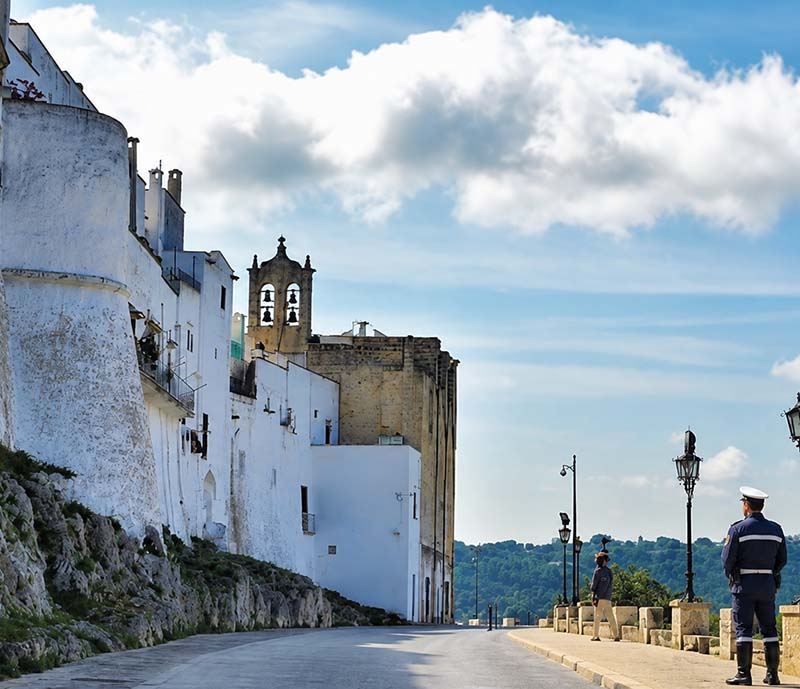
The route guides the listener through the historic centre, the cathedral, the Giudea, the sea view and the surrounding masserie, with fourteen chapters. The starting point is the city seen through the windshield as you climb.
A voice that knows the silences of winter
Through Salvatore, Localis tells the story of Ostuni's alleyways, its crowded summers and the silence of winter. His perspective is that of someone who has watched the place change with the seasons — the difference between August with a hundred thousand visitors and February with empty alleys. A perspective that understands both sides of a tourist city that is also a place where people live. Narrative voice built on Localis research and sources.
The guide starts with the text: historical research, declared sources and Localis editorial responsibility. The audio is generated with ElevenLabs; technology gives voice to the listening experience, while writing and source selection remain ours.
Where the story starts
Suggested starting point. Open in Maps to get directions — then press play.