Martina Franca — The Free City
Three hundred years of a dukedom through the city's historical memory.
How to listen
You can listen freely, or, where indicated, begin from the suggested starting point and walk through the place as the story unfolds. Localis is not turn-by-turn navigation: use your phone map to find your way.
- Runtime
- 29 min, 13 chapters
- Access
- After purchase, you receive an immediate link. Stream it or save it for offline listening before you begin.
- Languages
- Shown for each story
Guide facts
- Estimated distance
- 2.1 km on foot
- Number of stops
- 13 audio stories
- Route
- Walking route in the baroque center with short detours
- Accessibility
- Historic center with stone paving and mild slopes.
- What you need
- Headphones, a charged phone, and comfortable shoes.
Chapters
- 01 01 Intro — A Voice from the Dukedom 0:00
- 02 The Free City — Before the Caracciolo 1:27
- 03 Petracone V — The Duke Who Wanted to Impress 3:24
- 04 The Palace — Three Hundred Rooms and a Theatre 5:46
- 05 The Baroque — The Palaces and the Gates 7:56
- 06 The Blacksmith's Revolt 11:05
- 07 The Frescoes and the Secret of the Walled Room 13:19
- 08 The Music — Before the Festival 15:42
- 09 1806 — When It All Ended 18:24
- 10 The Festival — Opera in the Family Courtyard 21:04
- 11 The Capocollo — Oak Smoke and Vincotto 23:09
- 12 What Remains Today 25:07
- 13 Closing — A Discreet Farewell 27:33
Martina Franca: the audio guide to understanding the free city, the dukedom and the Festival
Not just another white village: three hundred years of baroque dukedom, a blacksmith's revolt, a walled-up room and an opera festival in the family courtyard.
Seeing Martina Franca is easy. Understanding what that palace is doing there is something else.
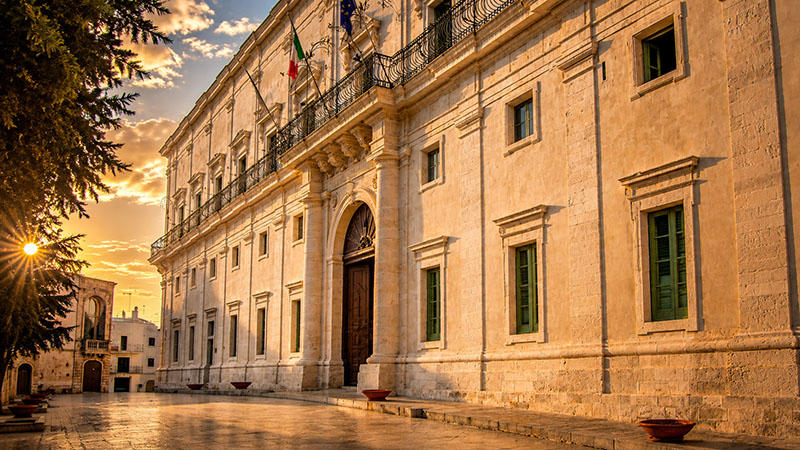
Every year tens of thousands of tourists walk through the alleys of Martina Franca without knowing that the Ducal Palace they pass in front of belonged to a single family — the Caracciolo — for three hundred years. Sixty thousand ducats in the seventeenth century. Three hundred rooms. An internal theatre. A project approved — it is said — by Gian Lorenzo Bernini without Bernini ever coming here.
Martina Franca is not a variation of Alberobello or Locorotondo. It is a city with a radically different identity — baroque, ducal, musical. The white alleys are there, but the historic centre is built around a palace, not around a market square. And every summer that palace becomes an opera stage: the Festival della Valle d'Itria has been running since 1975, has won the Premio Abbiati seven times and in the palace courtyard stages those rare operas that the major theatres do not dare to programme. This audio guide tells the story of that city.
Thirteen chapters from the fiefdom to the music
What makes this story different from any guide to Puglian baroque? The fact that it comes from inside. The narrative voice is a descendant of the Caracciolo family — anonymous by choice — who tells the story of the dukedom through family stories: the blacksmith Capo di Ferro's revolt in 1646, the Piano Nobile frescoes commissioned by Francesco III, the room that was walled up when the French arrived in 1806, and how power ends — not in battle, but slowly, room by room.
The route guides the listener through the baroque centre and in front of the Ducal Palace, with thirteen chapters covering three hundred years of history and a capocollo smoked with oak. Thirty minutes to understand a city that is worth much more.
A voice that comes from the dukedom
A narrative voice accompanies the story of the dukedom, the Caracciolo and the historical memory of Martina Franca. The perspective is that of someone who knows this place not as a tourist but from inside — family oral legends alongside verifiable historical facts. Narrative voice built on historical research and Localis sources, with an explicit distinction between documented history and oral tradition.
The guide starts with the text: historical research, declared sources and Localis editorial responsibility. The audio is generated with ElevenLabs; technology gives voice to the listening experience, while writing and source selection remain ours.
Where the story starts
Suggested starting point. Open in Maps to get directions — then press play.