Locorotondo — The Round Village
Twenty-five minutes, a village that goes in circles, and a wine that tastes like wind.
How to listen
Listen when you're ready to understand — in your room, on a train, or on location. Localis is not turn-by-turn navigation: it gives you context, history, and the perspective of someone who lives here, so you understand where you are.
- Runtime
- 32 min, 12 chapters
- Access
- After purchase, you receive an immediate link. Stream it or save it for offline listening before you begin.
- Languages
- Shown for each story
Guide facts
- Estimated distance
- 1.9 km on foot
- Number of stops
- 12 audio stories
- Route
- Walking route with panoramic stops
- Accessibility
- Historic center with smooth stone sections and gentle slopes.
- What you need
- Headphones, charged phone, and water.
Chapters
- 01 Intro — The Itria Valley from the Window 0:00
- 02 Locus Rotundus — The Village That Goes Round 2:18
- 03 San Giorgio and the Piazza 4:23
- 04 The Cummerse — Not Trulli 6:56
- 05 The Wine Cooperative 9:39
- 06 The White and the Lime 13:03
- 07 The Vineyard — Verdeca and Bianco d'Alessano 15:28
- 08 The Microclimate and the Masserie 18:12
- 09 The Olive Oil and the Lavender 21:41
- 10 What to Eat and Where 25:03
- 11 The View — Balcony of the Valley 28:10
- 12 Closing — Francesco Says Goodbye 30:14
Locorotondo: the audio route to understanding the round village and its wine
It is not Alberobello: it is a white village on the ridge that has been going round in circles for a thousand years, with a wine that tastes of limestone and wind.
Arriving in Locorotondo is easy. Understanding why it is different from everything else is something else.
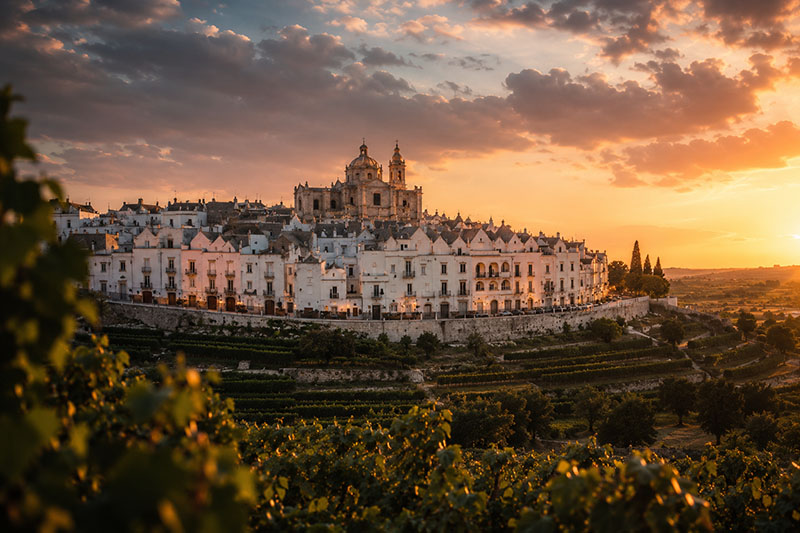
Every year tens of thousands of tourists reach the Valle d'Itria with Alberobello in mind and Locorotondo as a secondary stop. They are wrong. Locorotondo is the edge of the valley — built on a hill four hundred and ten metres above sea level, with a historic centre that is literally round because the Latin name is locus rotundus. The houses arrange themselves in concentric rings around the church of San Giorgio, like the ripples from a stone dropped in water.
The roofs of Locorotondo are not trulli cones: they are cummerse — double-pitched roofs in limestone slabs, built that way because it rains more here than on the plain and a conical roof drains water poorly. Every construction detail answers a precise climatic problem. And the vines on the ridges have been producing Locorotondo DOC since 1969 — Verdeca and Bianco d'Alessano, two native grape varieties that do not grow well anywhere else. This audio story tells the story of that village and those vineyards.
Twelve chapters from the windshield to the valley balcony
What makes this route different from any village guide? The fact that it connects architecture, agriculture and landscape. You will understand why the white of the facades is not just aesthetic — lime was antibacterial before disinfectants existed. You will discover the history of the wine cooperative, founded by local winemakers to manage together what they could not have achieved alone. And you will hear how lavender essential oil is produced — two thousand kilos of flowers for one litre.
The route guides the listener through the historic centre and the surrounding landscape, with twelve chapters covering the village from history to agriculture. The final stop is the viewpoint — from there you can see the whole Valle d'Itria.
A voice that knows every vine root
Through Francesco, Localis tells the story of the connection between the village, the vineyards and the products of the Valle d'Itria. His perspective is that of the winemaker who has roots in the same land he cultivates — the Verdeca that grows in the valley floor, the Bianco d'Alessano on the ridges, the oil from olive trees that are not planted but already there. Narrative voice built on Localis research and sources.
The guide starts with the text: historical research, declared sources and Localis editorial responsibility. The audio is generated with ElevenLabs; technology gives voice to the listening experience, while writing and source selection remain ours.
Where the story starts
Suggested starting point. Open in Maps to get directions — then press play.