The Margherita Salt Flats — Salt and Flamingos
Margherita di Savoia, Manfredonia, Siponto. Italy's largest salt works and the city buried under the sand.
How to listen
You can listen freely, or, where indicated, begin from the suggested starting point and walk through the place as the story unfolds. Localis is not turn-by-turn navigation: use your phone map to find your way.
- Runtime
- 23 min, 9 chapters
- Access
- After purchase, you receive an immediate link. Stream it or save it for offline listening before you begin.
- Languages
- Shown for each story
Guide facts
- Number of stops
- 9 audio stories
- Route
- Self-paced walking route
- Accessibility
- Historic center with mixed paving. Suitable for most visitors.
- What you need
- Headphones and a charged phone.
Chapters
- 01 The six o'clock shift 0:00
- 02 The salt flats: how salt works 0:23
- 03 The pink flamingos 3:42
- 04 Margherita di Savoia: the city of salt 7:06
- 05 The Gulf of Manfredonia 10:25
- 06 Manfredonia: the founder's city 13:05
- 07 Siponto: the abandoned city 15:26
- 08 The Basilica of Santa Maria di Siponto 18:17
- 09 The transhumance: the Gargano droving roads 20:38
The Margherita Salt Flats: the audio guide to salt, flamingos and a vanished city
Not a postcard landscape: the place where salt is still alive, flamingos decide when they arrive and a city is buried under the sand.
Passing through Margherita di Savoia is easy. Understanding what you're looking at is something else.
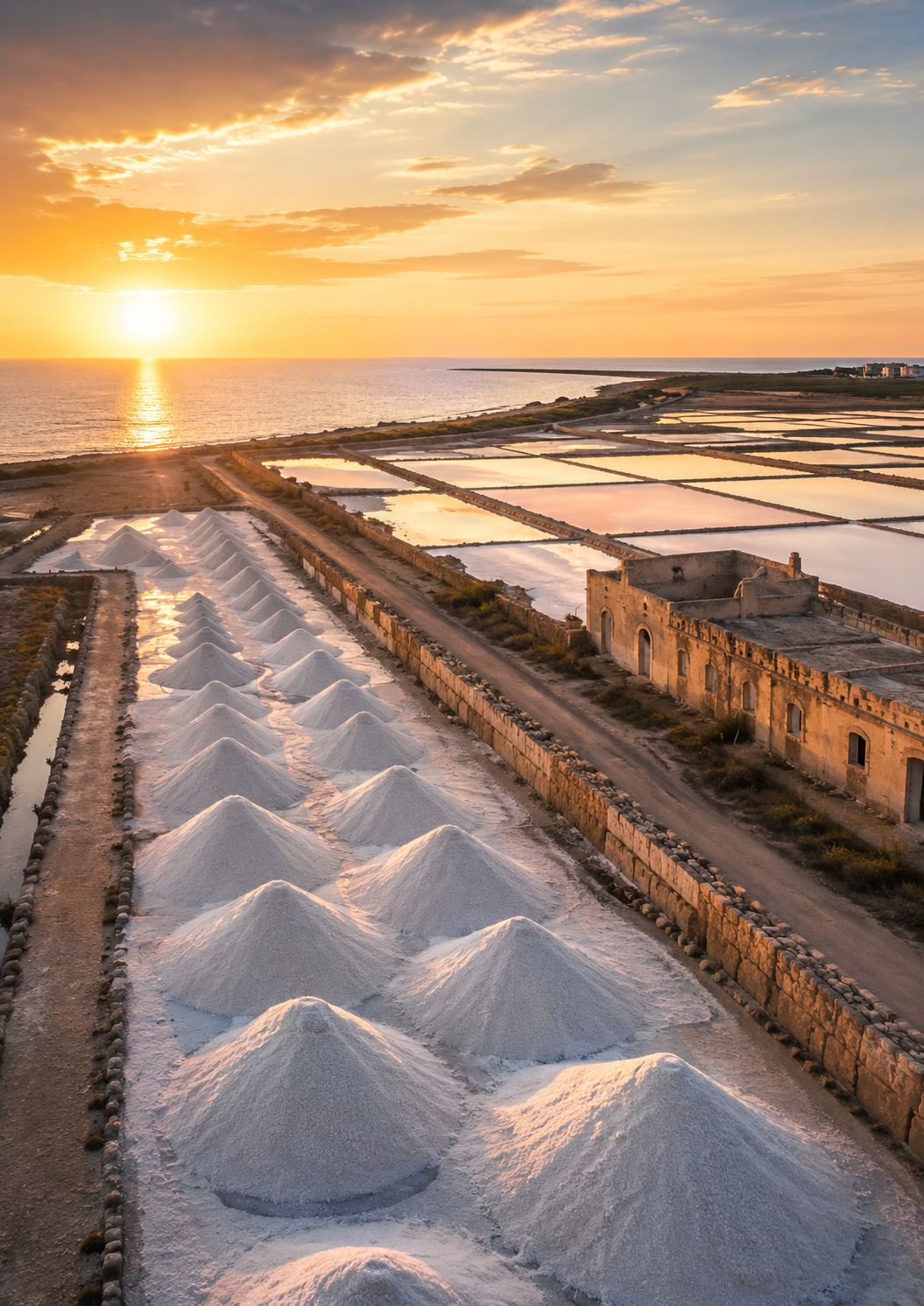
Every summer thousands of tourists drive past the Margherita di Savoia salt flats on their way to Gargano. They see a pink mirror and photograph it. They don't know they are looking at Italy's largest salt works — four thousand hectares where the water changes colour with the seasons — or that in July flamingos take flight together in their thousands.
The salt flats are not an artificially tinted lake. They are a biological system where halophilic bacteria produce the pigments that colour the water, where salt is harvested as it was in antiquity, and where a few kilometres away lies Siponto — a medieval city abandoned in 1223 after an earthquake and left buried under the sand for eight hundred years, with its Romanesque basilica still standing. This audio guide tells what the landscape does not.
Nine chapters from the six o'clock shift to the buried city
What makes this route different from any nature guide? The fact that it does not separate landscape from history. You will hear how the salt cycle works — from the evaporation basin to the bag you buy at the market. You will hear the story of Manfredonia, founded by Manfred of Swabia in 1256 with a precise urban plan after the destruction of Siponto. And you will understand why the basilica of Santa Maria di Siponto survived everything — earthquake, abandonment, centuries of sand.
The route guides the listener among the salt basins, the Gulf of Manfredonia and the remains of Siponto. Twenty-three minutes, nine chapters — from the six o'clock morning shift to the transhumance that crossed these droving roads.
A voice that knows the rhythm of the basins
Antonello tells the story of the salt flats, the work of salt and the landscape of the Margherita di Savoia basins. His perspective is that of someone who has learned that salt is not just an industrial product — it is a biological system with its own seasons, colours and animals. Narrative voice built on Localis research and sources.
The guide starts with the text: historical research, declared sources and Localis editorial responsibility. The audio is generated with ElevenLabs; technology gives voice to the listening experience, while writing and source selection remain ours.
Where the story starts
Suggested starting point. Open in Maps to get directions — then press play.