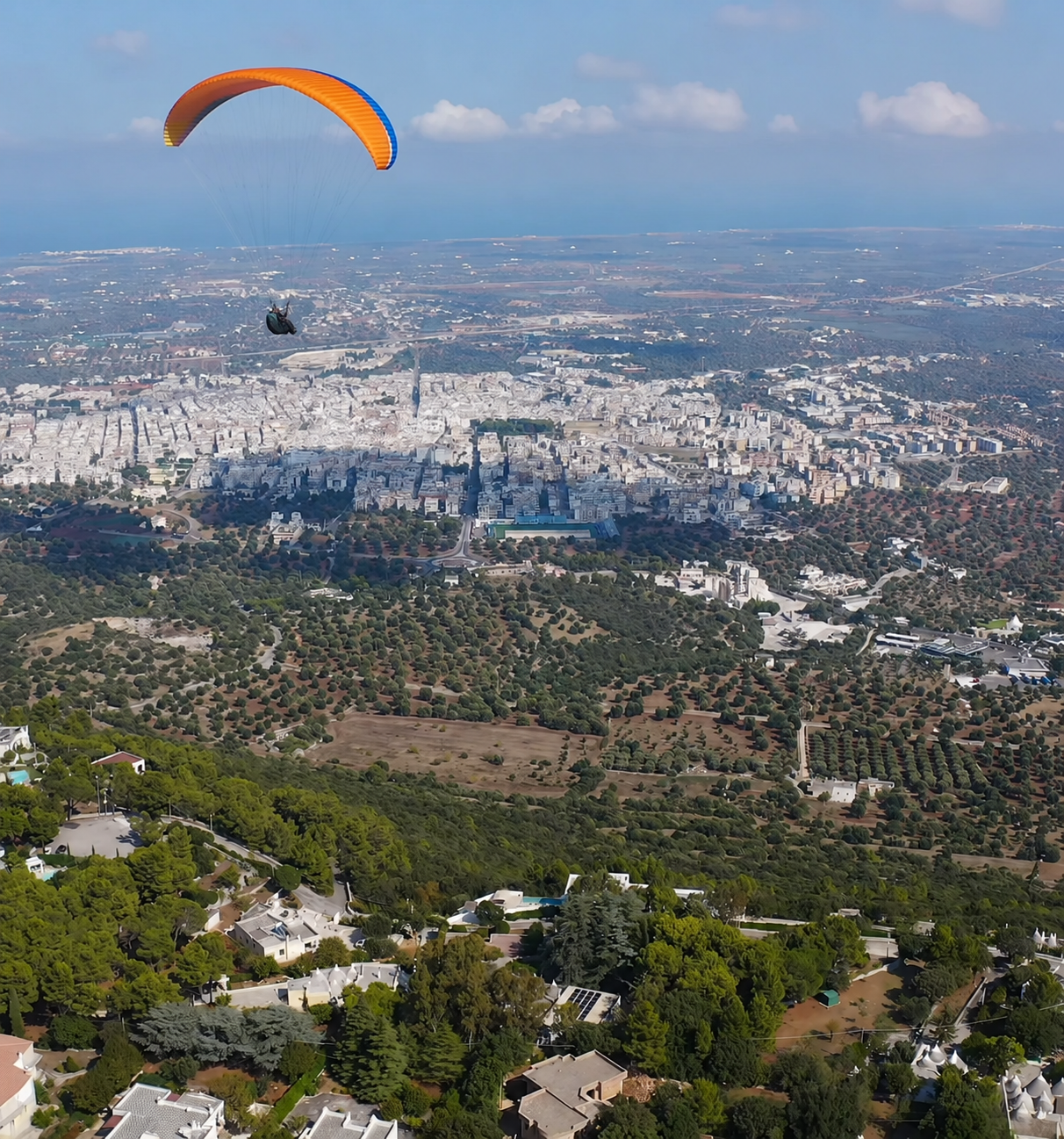
Fasano / Selva di Fasano — The Valley Seen from Above
The Valle d'Itria seen from above, between trulli, masserie and hills.
How to listen
Listen when you're ready to understand — in your room, on a train, or on location. Localis is not turn-by-turn navigation: it gives you context, history, and the perspective of someone who lives here, so you understand where you are.
- Runtime
- 36 min, 16 chapters
- Access
- After purchase, you receive an immediate link. Stream it or save it for offline listening before you begin.
- Languages
- Shown for each story
Guide facts
- Number of stops
- 16 audio stories
- Route
- Self-paced walking route
- Accessibility
- Historic center with mixed paving. Suitable for most visitors.
- What you need
- Headphones and a charged phone.
Chapters
- 01 Intro — Climbing Toward Selva 0:00
- 02 Fasano and Selva — Two Towns, One Soul 2:29
- 03 Selva di Fasano — The Village on the Plateau 4:42
- 04 The Flight — What Andrea Sees from Above 7:04
- 05 The Masserie — The Real Ones and the Postcard Ones 9:37
- 06 The History of Fasano — A City of Passage and Gateway to Egnathia 11:52
- 07 Egnathia — The City the Sea Almost Swallowed 14:33
- 08 The Park of Monumental Olive Trees 17:17
- 09 Thermal Currents and the Sky Above the Valley 19:34
- 10 Dawn from Selva — The Best Moment 21:44
- 11 The Food — Bombette, Dairy and What You Don't Expect 24:20
- 12 The Masserie as Agriturismo — The Phenomenon Seen from Outside 26:35
- 13 Sunset — The Moment for Flying 28:14
- 14 The Coast — Savelletri and the Sea That Changes Face 30:30
- 15 What to Do — The Perfect Day 32:26
- 16 Closing — Andrea Says Goodbye from the Sky 34:33
Fasano and Selva di Fasano: the audio route to understanding the Valle d'Itria from above
Not the plain: the high-up perspective that connects monumental olive trees, real masserie and a city buried by the sea two thousand years ago.
Climbing toward Selva di Fasano is easy. Understanding what you're looking at is something else.
Every year thousands of tourists drive toward the Valle d'Itria staring at their sat nav. Very few look out of the window as they climb toward Selva di Fasano — and they miss the geometry of the valley as it cannot be seen from anywhere else: trulli among the olive trees, white masserie, rows of vines, dry-stone walls dividing the limestone into irregular pieces. This is the Valle d'Itria seen from above.
Fasano is not just the place from which you descend to the sea at Savelletri. It is the place from which you see the valley. And beneath Fasano, a few kilometres toward the coast, lies Egnathia — a Messapian, then Roman, then medieval city, abandoned in the thirteenth century because the sea was advancing. A city the earth has almost swallowed that still today yields mosaics, columns and fragments of consular roads. This audio story tells both perspectives.
Sixteen chapters from takeoff to sunset
What makes this route different from any Valle d'Itria guide? The fact that it starts from above. Andrea tells the story of the geometry of trulli, masserie and hills from the perspective of someone who has seen them from the air — the thermal currents above the valley, the difference between a real masseria and a postcard one, the monumental olive trees in the park that are eight hundred years old and did not come from Italy but from Syria.
The route guides the listener through Fasano, Selva and the surrounding landscape, with sixteen chapters covering the territory from dawn to dusk. The best moment to understand the valley is from up here.
A voice that observes from above
Through Andrea, Localis observes the geometry of trulli, masserie and hills from a high perspective over the Valle d'Itria. His perspective is that of someone who has learned to read the landscape not at road level but from the air — the direction of the dry-stone walls, the position of the masserie, the relationship between limestone and cultivation. Narrative voice built on Localis research and sources.
The guide starts with the text: historical research, declared sources and Localis editorial responsibility. The audio is generated with ElevenLabs; technology gives voice to the listening experience, while writing and source selection remain ours.
Where the story starts
Suggested starting point. Open in Maps to get directions — then press play.