Alberobello — Inside the Trulli
Twenty-five minutes, a thousand years of stone, a story nobody ever told you.
How to listen
Listen when you're ready to understand — in your room, on a train, or on location. Localis is not turn-by-turn navigation: it gives you context, history, and the perspective of someone who lives here, so you understand where you are.
- Runtime
- 23 min, 12 chapters
- Access
- After purchase, you receive an immediate link. Stream it or save it for offline listening before you begin.
- Languages
- Shown for each story
Guide facts
- Estimated distance
- 2.0 km on foot
- Number of stops
- 12 audio stories
- Route
- Walking route across historic districts and viewpoints
- Accessibility
- Some sections include slopes and uneven stone paving.
- What you need
- Headphones, a charged phone, and comfortable shoes.
Chapters
- 01 Intro — The Doorstep 0:00
- 02 What Is a Trullo, Really 1:24
- 03 The Stone and the Cistern 4:06
- 04 Rione Monti — The Showcase 6:39
- 05 After 1797 8:22
- 06 The Symbols on the Pinnacles 9:59
- 07 Aia Piccola — The Real One 11:44
- 08 The Trullo Sovrano 13:21
- 09 The Food of the Murgia 14:40
- 10 Living in a Trullo Today 17:57
- 11 The Church of Sant'Antonio 19:30
- 12 Closing — Concetta Says Goodbye 21:06
Alberobello: the audio route to understanding the trulli and the city that built them
Not the postcards: why the trulli have no mortar, what is written on the pinnacles, and what it is like to still live inside one.
Seeing the trulli is easy. Understanding why they are built that way is something else.
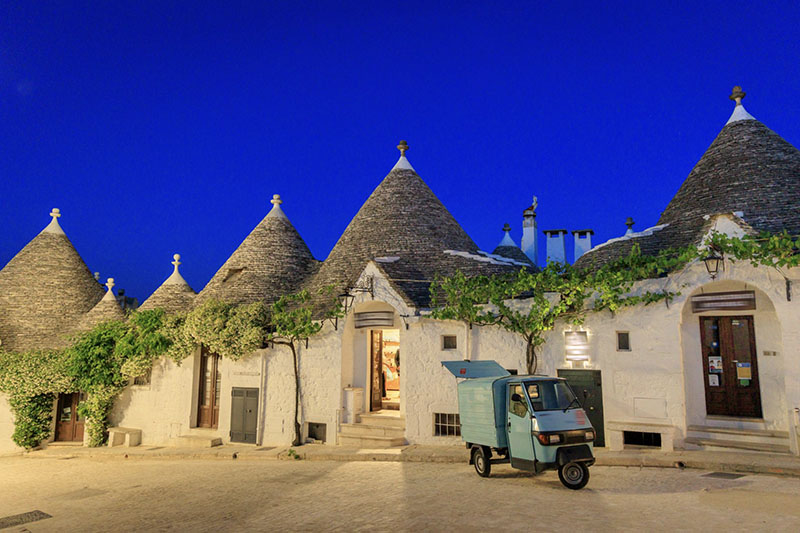
Every year three million visitors walk through Rioni Monti and Aia Piccola in Alberobello photographing the limestone cones. Most people know the trulli are beautiful. Almost no one knows why they were built without mortar — and the answer has to do with feudalism, Bourbon taxation and a Count who did not want to pay dues to the King of Naples.
The trulli are not an architectural curiosity born from the imagination of some Puglian peasant. They are the practical answer to a precise problem: how to build habitable houses in a way that could technically be dismantled before a royal inspector's visit. A house without mortar is not a permanent settlement. And if it is not a permanent settlement, the King does not need to know it exists. This audio story tells that story.
Twelve chapters from the entrance gate to the Trullo Sovrano
What makes this route different from any UNESCO site visit? The fact that it does not stop at the surface. You will discover the symbols painted in white lime on the pinnacles — more than two hundred types catalogued, of uncertain origin between the sacred, the magical and the practical — and why no one really knows what they mean. You will understand the difference between the Rione Monti of souvenir shops and the Rione Aia Piccola where real families still live.
The route guides the listener through the two historic districts and the viewpoints, on foot and at their own pace. Twenty-five minutes, twelve chapters — from the intro on the Murgia seen through the windshield to Concetta's farewell.
A voice that knows the stone from inside
Through Concetta, the story enters the daily life of the trulli: stone, water, cold and the transformations of Alberobello. Her perspective is that of someone who has learned to understand these places not as scenery but as answers to real problems — heat, cold, damp, feudal taxation. Narrative voice built on Localis research and sources.
The guide starts with the text: historical research, declared sources and Localis editorial responsibility. The audio is generated with ElevenLabs; technology gives voice to the listening experience, while writing and source selection remain ours.
Where the story starts
Suggested starting point. Open in Maps to get directions — then press play.