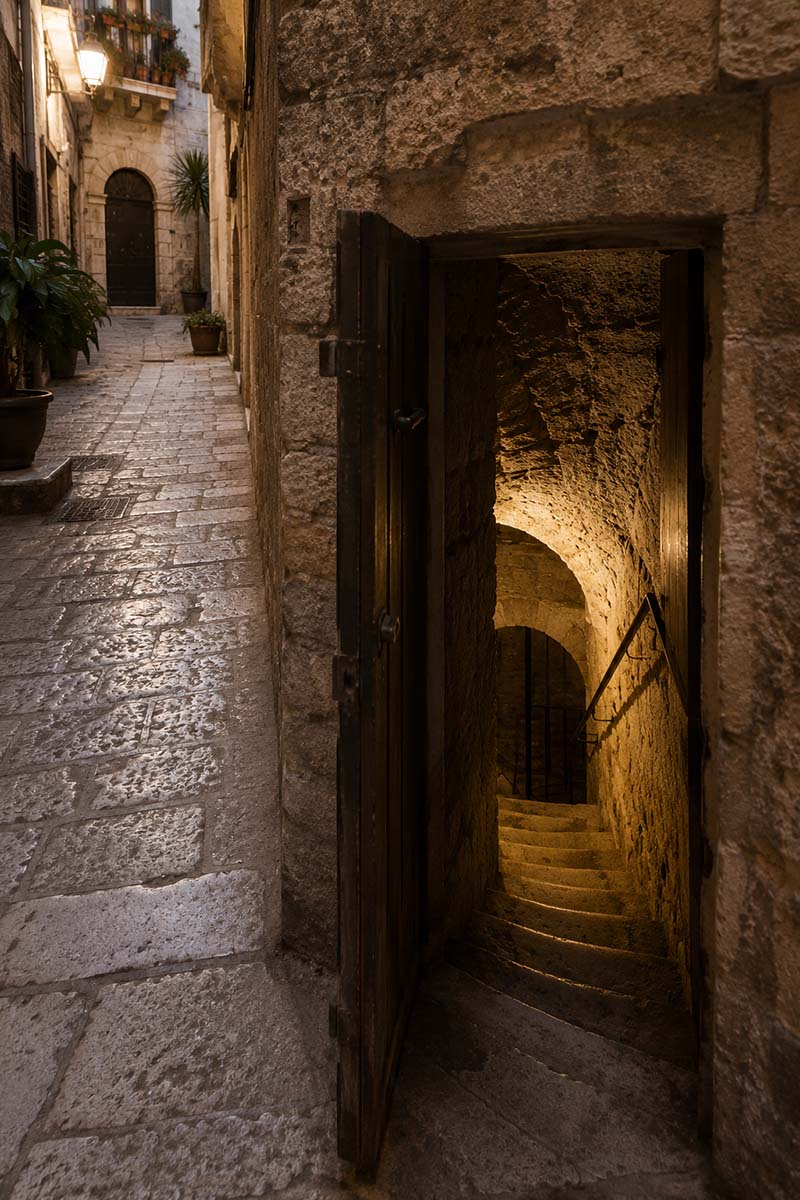
You walk Bari’s old town at street level and think you’ve seen it. But the town you cross is only the latest layer of a city that has built on top of itself for two thousand years. A few metres beneath your feet there are Roman cisterns, crypts, early-Christian mosaics, Norman-Swabian vaults. It’s another Bari, and it tells you things the one above has forgotten.
This guide is for understanding what’s down there — and why it’s worth going below.
What to See in Underground Bari
1. The four Baris stacked on top of each other
Bari isn’t an old city with a few ruins: it’s a city built over and over on the same spot. Roman Barium, the Byzantine and early-Christian town, the Norman-Swabian city, the modern one. Each era reused the foundations of the last — and when you dig beneath the old town, you find them one above the other.
That’s what “underground Bari” really means: not a single place, but the layers of a city that never stopped standing in the same spot.
2. Beneath the Cathedral of San Sabino
The archaeological area beneath the Cathedral of San Sabino is where this is clearest. Under the floor of the Romanesque cathedral lie the remains of older buildings: an early-Christian basilica, traces of the Byzantine town, and floor mosaics from late-antique and early-medieval times, preserved a few metres below the present church.
It explains the layering better than any sign: you stand beneath a 12th-century church, looking at the floor of a church centuries older.
3. The crypt of San Nicola
The Basilica of San Nicola has its own underground dimension: the crypt, where the saint’s relics — brought to Bari in 1087 — are kept, with its columns and capitals from different eras. It’s the oldest and most sacred space in the basilica, the one that explains why it exists at all.
Going down into the crypt isn’t a detail of the visit: it’s the heart of the pilgrimage that for almost a thousand years has drawn Orthodox and Catholic visitors to Bari from across the world.
4. The Roman cisterns
Beneath the squares of the old town — especially around Piazza Mercantile — there are traces of the Roman water system: cisterns dug to collect rainwater, essential in a seaside city with no rivers. They were the invisible infrastructure that let Bari exist.
Seeing them is a reminder of something the city above hides: before being beautiful, a city has to survive. Water came first.
5. The vaults of the Swabian Castle
The Norman-Swabian Castle has its own subterranean spaces: galleries, service rooms and defensive structures below the present level, part of the layout Frederick II built in the 13th century. The castle wasn’t only what you see from outside — below, it kept going, with stores and passages.
How to Visit Underground Bari
Bari’s underground spaces aren’t a single continuous route: they’re separate sites beneath churches, squares and monuments. Some you can see on your own (the crypt of San Nicola), others only with guided tours that open rooms normally closed.
Practical tip: opening hours and access to some of the hypogea change often and depend on who manages them. Check before your visit, especially for the archaeological area beneath San Sabino and for guided routes through private spaces.
What the Usual Guides Don’t Show
Tours show you the spaces. What often gets left out is the meaning: why a city builds on top of itself, what it means that beneath one church there’s another, why water decided where Bari would rise.
The Underground Bari — What Lies Beneath audio story is built on that logic: four eras, a city beneath the city, told as you go down. Around half an hour that changes the way you walk at street level too.
Frequently Asked Questions about Underground Bari
What can you see in underground Bari?
Roman cisterns, the archaeological area with the mosaics beneath the Cathedral of San Sabino, the crypt of the Basilica of San Nicola and the underground spaces of the Swabian Castle. They are the oldest layers of the city, below the present old town.
Can you visit underground Bari for free?
The crypt of San Nicola is free to enter. The archaeological area beneath San Sabino and the guided underground routes may charge a ticket. Check on the spot, as management and hours change.
How long does it take?
For the main sites, one or two hours is enough, depending on how many spaces are open and whether you take a guided tour. It’s an excellent add-on to a walk through Bari’s old town.
Do you need to book?
For the crypt of San Nicola, usually not. For guided tours of the underground spaces it’s worth booking, especially in high season: places are limited.
Is it suitable for children?
Yes, but these are spaces with stairs, uneven floors and little light. Comfortable shoes and some care. For younger ones, a story helps keep their attention.
Sources and method
This article is written and reviewed by Localis. The project’s sources are collected on the Sources page. For the full editorial method see The Localis method.