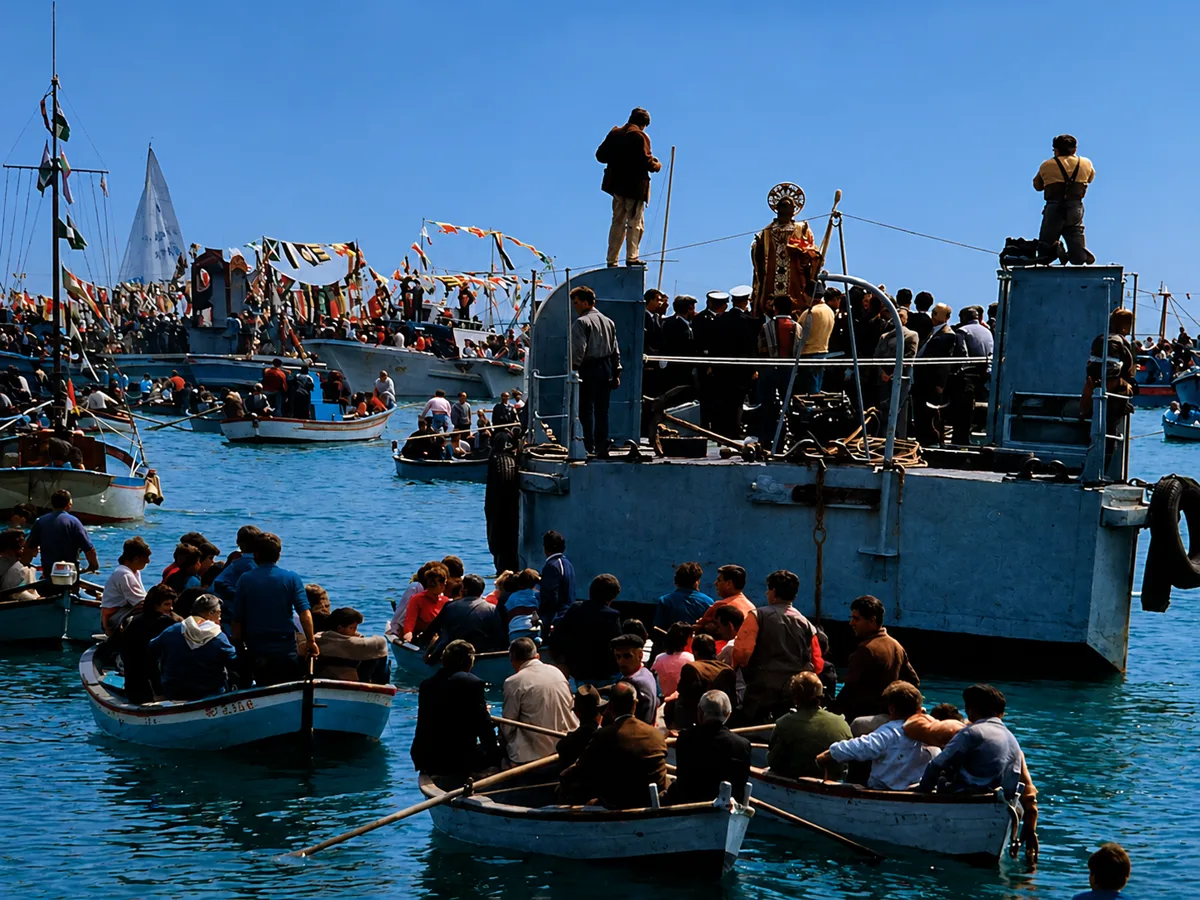
Once a year, Bari goes out to bring its saint home from the sea. Thousands of people on boats, rowing boats, anything that floats, crowd around a golden statue and escort it back to shore. It’s been happening like this for centuries, and it’s the moment you understand that San Nicola, in Bari, is not just any saint: he’s the city itself.
The Feast of San Nicola is Bari’s most important festival. To an outsider it can look like folklore; to the Barese it’s memory, identity and an appointment no one misses. Here’s what happens, and why.
When and what is celebrated
The feast is held every year on 7, 8 and 9 May and commemorates the translation of the relics of Saint Nicholas: in 1087, according to tradition, a group of Bari sailors (the city’s memory speaks of sixty-two men) brought the saint’s bones to Bari from Myra, in Lycia (modern Turkey). Everything springs from that arrival: the basilica built to house them, and the festival that re-enacts it every spring.
That’s why San Nicola “arrives from the sea”: because it was from the sea that he really arrived.
The historical procession (7 May)
The feast opens with the historical procession: hundreds of costumed figures in Byzantine and medieval dress — tunics, turbans, velvets, the saint’s golden icon — parade through the streets of the old town, re-enacting the arrival of the relics. It’s not just any costume parade: it’s Bari staging, for itself, the day that made it famous in the Christian world.
San Nicola arrives from the sea (8 May)
This is the festival’s signature image. The statue of San Nicola is loaded onto a boat and taken out to sea, followed by a flotilla of fishing boats and anyone who can put out to water. The saint spends the day on the sea and returns in the evening, welcomed by an enormous crowd. It’s a sea procession that symbolically recreates that ancient landing — and one of the most intense collective rituals in all of Puglia.
The procession through the streets
Alongside the rite on the sea, the statue is carried shoulder-high in procession through the streets of the old town, between walls of people, old women waiting at the front, hands raised as it passes. Old photos and today’s are almost identical: the clothes change, not the gestures. It’s the proof that here devotion isn’t spectacle, but continuity.
The Basilica di San Nicola
Everything turns around the Basilica di San Nicola, in the heart of old Bari: one of the great Romanesque churches of southern Italy, built at the end of the 11th century precisely to house the newly arrived relics. The façade, tall and severe as a fortress, is one of the city’s symbols. It was a building site begun to give the saint a worthy home: the basilica was born with and for his bones.
The crypt and the Holy Manna
Below the basilica is the oldest and most charged part: the crypt, a forest of columns over a mosaic floor, where the saint’s relics rest. It’s one of the few places in the world where Catholics and Orthodox pray to the same saint, in the same space: pilgrims come to Bari from Greece, Russia and all the Christian East.
Here, too, one of the most unusual rites takes place: every year, on the morning of 9 May, a clear liquid is collected from the relics, the Holy Manna (Santa Manna), held precious by the faithful. It’s an ancient rite that has been repeated, unbroken, for centuries.
San Nicola, that is, Santa Claus
Here’s the detail that throws outsiders: the San Nicola of Bari is the same Saint Nicholas who, transformation after transformation, became the Santa Claus known all over the world. The 4th-century bishop, protector of children and sailors, is the root of the Christmas figure. So when you stroll through old Bari, you’re walking past the “real” Santa Claus.
How to experience it and practical tips
- The dates: 7-8-9 May. The historical procession on the 7th, the sea procession on the 8th, the Holy Manna on the 9th.
- Arrive early: the city is packed, especially along the seafront and in old Bari.
- Respect the rites: the basilica and crypt are places of living worship, not just monuments.
- Outside the feast too: the basilica and crypt can be visited all year, the quietest way to understand where it all comes from.
For more of underground and medieval Bari, read also Underground Bari, and the dedicated audio story below tells the saint’s full story.
What the usual guides don’t show you
Guides give you the dates and tell you there’s a procession. They don’t tell you why Bari goes out to fetch its saint from the sea, what that landing in 1087 meant, why two Churches pray together in the same crypt.
The audio story San Nicola — The Stolen Saint tells exactly this: the theft of the relics, the arrival in Bari, the birth of a cult that has crossed the centuries. It doesn’t replace the feast — it makes you understand what you’re looking at.
Frequently asked questions about the Feast of San Nicola
When is the Feast of San Nicola in Bari?
The main feast is held every year on 7, 8 and 9 May: the historical procession on the 7th, the sea procession on the 8th, the drawing of the Holy Manna on the 9th. San Nicola is also celebrated on 6 December.
What is the sea procession of San Nicola?
On 8 May the statue of San Nicola is taken out to sea on a boat, followed by a flotilla, and brought back to shore in the evening. It symbolically re-enacts the arrival of the relics from the sea in 1087.
What is the Holy Manna of San Nicola?
It’s a clear liquid that every year, on 9 May, is collected from the saint’s relics in the crypt of the basilica. It’s considered miraculous by the faithful and is the object of a very ancient rite.
Why is San Nicola linked to Santa Claus?
Saint Nicholas of Myra, a 4th-century bishop and protector of children, is the origin of the figure of Santa Claus, which evolved over the centuries through northern European traditions. His relics have been in Bari since 1087.
Can you visit the crypt of San Nicola all year round?
Yes. The basilica and the crypt are open for worship and visits all year. The crypt, where the relics rest, is also a place of prayer for Orthodox faithful.
Sources and method
This article is written and reviewed by Localis. The project’s sources are collected on the Sources page. For the full editorial method, see The Localis method.