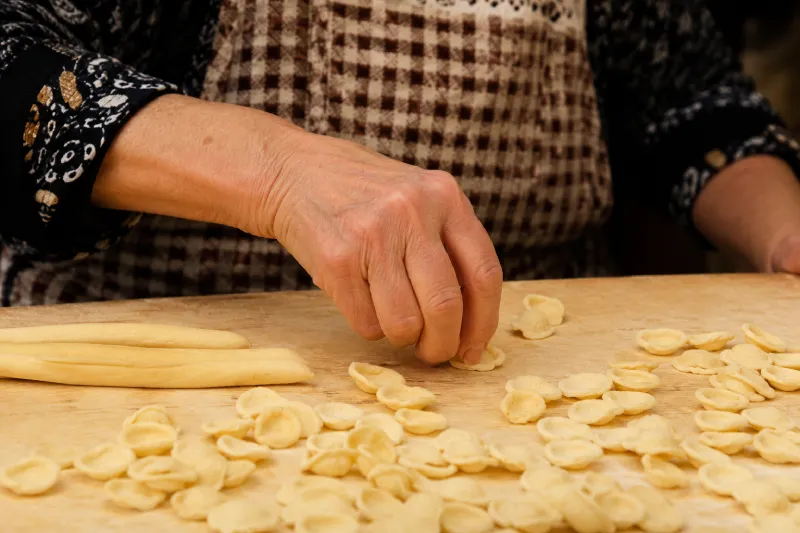
Arriving in Bari Vecchia and not quite knowing what you’re looking at happens to everyone. The women sitting on low stools in front of their doorways, the quick flick of a knife across a wooden board, the row of orecchiette laid out to dry on a white cloth — it looks like a performance. It isn’t. They’ve always done it this way, and heaven forbid they’d stop for the tourists.
This article is about what orecchiette are, how they’re made, where they come from and where you can watch them being made in person. The short history of the most Bari food there is.
What orecchiette are
The name already tells you: orecchiette means little ears. The shape — hollow in the middle, with a raised edge and a rough surface — isn’t an aesthetic choice. It does a job. The roughness holds the sauce; the hollow catches the pieces of vegetable or meat. Every detail has a practical reason.
They’re made with re-milled durum wheat semolina and water. Nothing else. No eggs, no oil. The result is a firm pasta that can stand up to long cooking without falling apart.
The shaping technique is what sets orecchiette apart from all the rest of Puglia’s pasta: a small piece of dough is dragged across the wooden surface with the blade of a kitchen knife — not the edge, the back — until it forms a thin disc that curls in on itself. The gesture takes a steady wrist, speed and years of practice. You don’t learn it by watching a video.
Where they’re made by hand: the street in Bari Vecchia
In the heart of Bari Vecchia, in the little streets near the Cathedral — around Via dell’Arco Basso in particular — orecchiette are still made out in the street. Women sit in front of their own doorways, trays balanced on stools or small tables, a steady rhythm all day long.
It isn’t a folkloric reconstruction. It’s work. The orecchiette you see being laid out on the white cloth end up in the plastic bags you’ll find on sale right there, or in the old town’s restaurants. The price is the price of pasta made by hand by someone who knows how.
Walk by slowly. Look without crowding too close. If someone smiles, smile back. If you’re lucky, someone will press a bit of dough into your hand and show you just how hard that gesture really is.
The three traditional sauces
In Bari, orecchiette are eaten three ways, and each one is an answer to a different season or occasion.
Cime di rapa
It’s the most famous combination, and the most Bari of them all. The cime di rapa — turnip tops, the slightly bitter flowering shoots — are sautéed in a pan with garlic, chilli and oil, then tossed straight in with the orecchiette while they’re still hot. The vegetable’s bitterness balances the dense texture of the pasta. In Bari it’s eaten this way from autumn to spring, when the cime di rapa grow in the Puglia fields.
Sugo di braciola
On Sundays, or whenever you want to do something properly, you make sugo di braciola: a beef roll — with parsley, garlic, cheese and hard-boiled egg inside — that simmers for hours in the tomato sauce. The sauce dresses the orecchiette; the meat is eaten afterwards, as a second course. It’s the sauce of patience.
Fresh tomato and ricotta forte
In summer, with Puglia tomatoes that actually taste of tomato, the orecchiette get a simple dressing: cherry tomatoes raw or barely seared, good oil, basil. And on top — this is the detail that changes everything — ricotta forte: an aged, sharp ricotta with a dense paste that crumbles over the plate. If you haven’t yet eaten ricotta forte, you haven’t yet eaten in Bari.
The history of orecchiette
Orecchiette have been documented in Puglia since the Middle Ages, though the exact date they first appeared is hard to pin down. The technique of dragging the dough across the surface with a knife is similar to other methods found across southern Italy and the eastern Mediterranean — no surprise, given that Puglia was a crossroads of trade, peoples and different cuisines.
What’s certain is that durum wheat semolina was the dominant flour in Puglia — durum wheat grows well in the region’s dry, limestone climate, and Puglia is still one of Italy’s biggest producers today. Orecchiette were (and are) the most effective way of turning that semolina into pasta without machinery: all you need is your hands, a board and a knife.
In the home cooking of Bari, orecchiette weren’t a special dish. They were the everyday meal — cheap, filling, adaptable to whatever was around. On Sundays they became braciola; on weekdays they took in the leftover cime di rapa.
How to recognise a good orecchietta
A handmade orecchietta is different from the industrial kind in three ways:
Surface: the handmade one is irregularly rough — the wooden board leaves a texture that machines can’t replicate. It’s that roughness that holds the sauce.
Thickness: not uniform. The middle is thinner, the edge thicker. That gives an uneven cooking — the centre tends towards softness, the edge towards bite. It varies bite by bite.
Size: smaller than the industrial kind. Those who make them by hand tend to keep them compact.
Where to eat orecchiette in Bari
In Bari Vecchia there are several restaurants that make orecchiette as they should be made, mostly in the streets running around the Cathedral and down towards the harbour. There’s no need to look for the most touristy spot — quite the opposite, in fact.
For Bari food in the full picture — focaccia, panzerotto, sgagliozze, marinated mackerel and all the rest — the Bari at the Table audio story walks the city, stopping at the places and telling the food through the city’s history. It isn’t a restaurant guide: it’s a journey.
Frequently asked questions about Bari orecchiette
Where do you find the women who make orecchiette in Bari?
Around Via dell’Arco Basso and the little streets near the Cathedral of San Sabino, in the heart of Bari Vecchia. The morning is when there are more of them. There’s no fixed schedule — it’s daily work, not a show.
Can you buy fresh orecchiette in Bari Vecchia?
Yes. The women who make them in the street often sell retail too, in half-kilo or one-kilo bags. The price varies but is in line with artisanal fresh pasta.
Orecchiette with cime di rapa: when is the right time?
Cime di rapa grow in autumn and winter. The traditional dish is found fresh from roughly October to April. In summer you’ll still find it in restaurants, but made with frozen cime — it’s not the same thing.
What’s the difference between Bari orecchiette and orecchiette from elsewhere?
Orecchiette are found all over Puglia and parts of Basilicata, with local variations. The Bari ones are traditionally smaller and thinner. The version made by hand in the street in Bari Vecchia is the closest to the original shape — irregular, rough, alive.
Sources and method
This article was written and reviewed by Localis, drawing on the documented culinary tradition and direct experience of the city. For the historical and culinary context of Bari food, the project’s sources are collected on the Sources page. For the full editorial method see The Localis method.