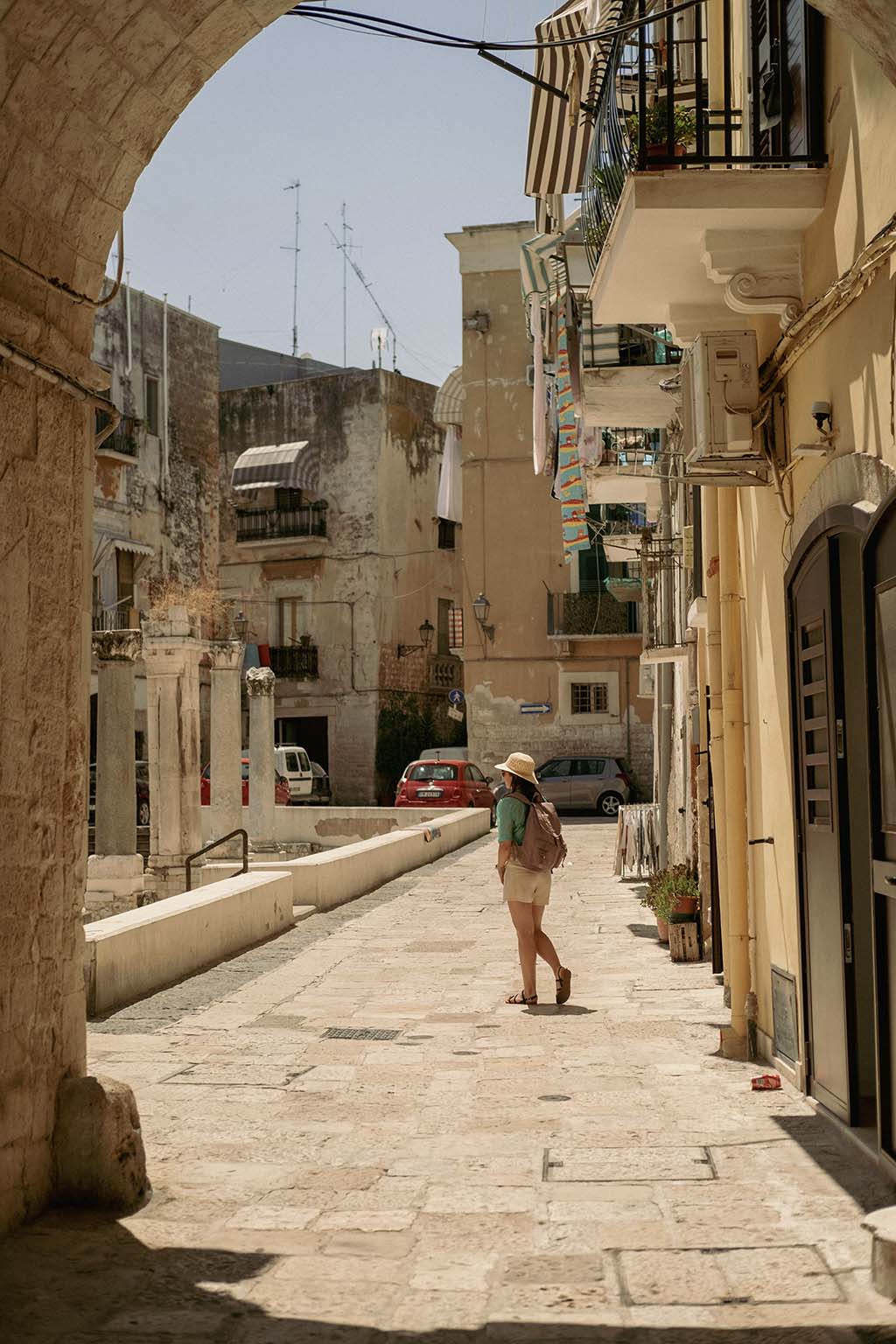
One day in Bari is enough — if you spend it the right way. The trouble with a lot of guides is that they slice the city into neighbourhoods as if it were a museum with separate rooms: first the Roman room, then the medieval one, then the modern one. Bari doesn’t work like that. The port, the old town, the Basilica and the seafront are ten minutes apart from one another, and they make more sense together.
This is the itinerary I’d follow myself: it starts early in the morning, it uses your legs, it’s in no hurry, and it gets you to the evening without having skipped anything essential.
Before you start: two things
Comfortable shoes. The alleys of Old Bari are paved with uneven limestone. Platform sandals don’t fit (literally, in some of the courtyards). Walking shoes or trainers.
No car inside Old Bari. Access is restricted. Leave the car in the car park by the port, or use public transport. On foot it takes less than fifteen minutes from the centre of modern Bari to the old town.
Morning: Old Bari (9:00–12:30)
Start from the main entrance to Old Bari, the one you reach from Piazza del Ferrarese or from the seafront. Go in without a precise plan: that’s intentional.
The alleys of Old Bari follow the logic of a defensive maze, not a grid. The old town was designed to confuse outsiders — and it still does. Wandering without a map for the first twenty minutes is the best way to begin.
The orecchiette street
First things first: look for the women making orecchiette by hand in front of their doorways, in the Via dell’Arco Basso area near the Cathedral. They’re there more consistently in the morning. The gesture — the knife dragging the dough across the wood — is lightning fast and comes from decades of practice. Watch, buy a bag if you like, and move on.
Basilica of San Nicola
The Basilica of San Nicola is the unmissable stop of the morning. Get there by 10:00 to beat the organised groups, which start arriving around 11.
Go in through the main façade. Take in the structure — the two towers, the arrangement of the windows, the almost military plainness of Puglian Romanesque. Then go down into the crypt: that’s where the relics of Saint Nicholas rest, and it’s there that you understand why Bari was a pilgrimage destination for nearly a thousand years.
Suggested time: 45–60 minutes, more if you want to take it slowly.
Cathedral of San Sabino
Five minutes from the Basilica, the Cathedral of San Sabino is the city’s cathedral — and it’s often overlooked by tourists, who stop at San Nicola. A mistake. The Cathedral was built on the ruins of an early Christian church, and it preserves some original elements in the apse. It’s older than the Basilica, less famous, quieter.
Suggested time: 20–30 minutes.
The Swabian Castle
Leave Old Bari heading north and reach the Norman-Swabian Castle, which you can see from outside the old town. The structure you see today is largely the result of the expansion ordered by Frederick II of Swabia in the 13th century.
The castle is home to the National Museum, with casts of medieval Puglian sculpture — worth a visit if the Middle Ages really interest you. If not, walk around the outer perimeter and look at the four corner towers: they’re enough on their own to grasp the difference between a defensive castle and an imperial residence.
Suggested time: 30–45 minutes (or more with the museum).
Lunch break: Bari food (12:30–14:00)
Old Bari has dozens of places to eat. The risk is ending up somewhere too touristy without realising it. A few practical pointers:
- Focaccia barese: you’ll find it in the bakeries of Old Bari. Eat it hot, with cherry tomatoes and olives. It isn’t a starter — it’s a meal.
- Orecchiette: if you haven’t bought any to cook at home, eat them in a restaurant now, while you’re still in the right setting.
- Fried panzerotto: don’t confuse it with the calzone — the Bari panzerotto is fried, small, filled with tomato and mozzarella. Eat it straight away, standing up.
Afternoon: Port and seafront (14:30–17:30)
After lunch, leave Old Bari towards the sea and reach the historic port.
The port of Bari isn’t just any quayside. The crusaders set sail from here in 1096, and the relics of Saint Nicholas arrived here in 1087. The San Nicola pier — the one facing the castle — is the spot where Bari’s medieval history is physically at its closest.
Walk along the quays towards the Lungomare Imperatore Augusto — the long, tree-lined avenue that runs beside the sea. It’s one of the most beautiful seafronts in southern Italy, with the old town on one side and the open sea on the other.
What the port of Bari carries with it — the full story is told in the Port of Bari — Where It All Happened audio story, thirteen chapters from the Roman port to the night of 1943.
Late afternoon: Modern Bari and Piazza Umberto I (17:30–19:00)
If you’re still on your feet — and you should be, Bari is flat — give the last part of the afternoon to Murat Bari: the modern quarter built in the early 19th century on a grid plan, which the locals simply call “the new town”.
Its centre is Piazza Umberto I, with the university and the Liberty-style buildings. From there, Via Sparano is the shopping street. The Petruzzelli Theatre, on Corso Cavour, is worth a detour for the façade alone — and the story of the theatre that burned down and was rebuilt is one of those Bari stories that explain the city better than many guides.
Evening: aperitivo and dinner (19:00 onwards)
In Bari, people dine late. The aperitivo starts around 19:00, dinner rarely before 21:00.
For the aperitivo: the bars on Piazza Mercantile or along the seafront are the right place. For dinner: head back to Old Bari if you want serious Bari food, or go to the spots in the Murat quarter for something more contemporary.
The audio stories for this itinerary
This itinerary touches four of Localis’s six Bari stories:
- Old Bari — Inside the City — the old town, the alleys, the logic of the defensive maze
- San Nicola — The Stolen Saint — the Basilica, the furtum sacrum of 1087, medieval ecumenism
- Port of Bari — Where It All Happened — the port, the crusaders, the night of 1943
- Bari at the Table — The Food That Holds the City Together — orecchiette, focaccia, panzerotto, the fish market
Frequently asked questions about Bari in one day
How much walking is there in this itinerary?
Roughly 6–8 km in total, spread across the day. It isn’t demanding: Bari is flat and the distances are short. With stops and visits, the total is very manageable.
Is it better to visit Old Bari in the morning or the afternoon?
In the morning, between 9 and 11, Old Bari is livelier — the women are making orecchiette, the markets are open, there are fewer tourists. The afternoon is quieter and the light on the limestone is beautiful, but some shops are closed over the lunch hour.
Can you do this itinerary with children?
Yes. Old Bari can be done with a pushchair only on the wider streets — the narrow alleys call for a carrier or a compact pushchair. The crypt of San Nicola and the Castle are accessible.
How long does it take to listen to the audio stories while you visit?
The Localis stories are made to be listened to on the spot, chapter by chapter. You don’t have to finish them in one sitting: press play when you enter an area, stop when you want to pause. The content runs 25–33 minutes each, but with the breaks the experience naturally stretches out.
Are there things to see in Bari that this itinerary doesn’t include?
Yes: Underground Bari (the archaeological area beneath the city) and the Three Theatres need extra time — an additional morning for the underground, an evening for a concert at the Petruzzelli. If you have two days in Bari, add these stops on the second day.
Sources and method
This article is written by someone who knows Bari and tells its story. The Localis audio stories are built on the same editorial foundation — historical research, Bari voices, first-person storytelling. For the full method, see The Localis method.